Written and medically reviewed by Kwaku Osafo-Mensah, MD
Pulmonary Medicine | Sleep Medicine | Diplomate, American Board of Sleep Medicine (ABSM)
Medically reviewed: September 2026.
Affiliate Disclosure: Sleep Breathing Guide may earn a commission if you purchase through certain links on this page, at no additional cost to you. Affiliate relationships do not determine which products we recommend or how we evaluate them.
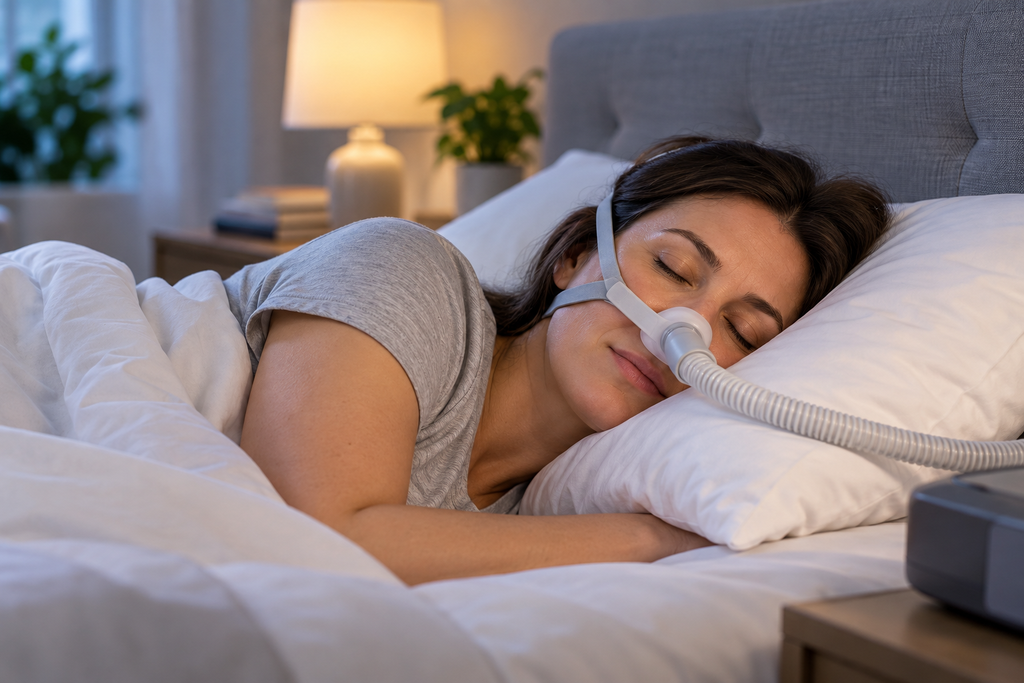
Low-profile CPAP mask designs may help reduce pillow interference and hose pull for some side sleepers.
How We Evaluated CPAP Masks for Side Sleepers
The Sleep Breathing Guide did not physically test every mask in this guide. Unless specifically stated otherwise, products were evaluated using manufacturer specifications, interface design, hose configuration, available product documentation, clinically relevant mask characteristics, retailer information, and factors particularly important to side sleepers. We do not describe a product as personally tested unless hands-on testing actually occurred.
What Are the Best CPAP Masks for Side Sleepers?
The best CPAP mask for side sleepers is not necessarily the smallest mask, the newest mask, or the mask with the highest online rating.
Side sleeping creates a particular mechanical problem:
Your face, CPAP mask, headgear, tubing, and pillow all have to coexist for several hours without repeatedly breaking the mask seal.
A mask that works perfectly while sitting upright may begin leaking when the side of the face presses into a pillow.
For many side sleepers, useful mask characteristics include:
- A relatively small facial footprint
- Limited structure projecting from the front of the face
- A cushion that remains stable with movement
- Flexible headgear
- Tubing that does not repeatedly pull on the mask
- Enough freedom to turn from one side to the other
- An interface appropriate for nasal versus mouth breathing
No single mask has all of these advantages for every patient.
Quick Picks: Best CPAP Masks for Side Sleepers
Based on current manufacturer specifications, interface design, hose configuration, clinically relevant mask characteristics, and factors particularly important to lateral sleeping, our current selections are:
Best Overall: ResMed AirFit P30i
Best for: Side sleepers and active sleepers who tolerate nasal pillows and want the main hose connection away from the front of the face.
Why it stands out:
- Nasal pillows interface
- Top-of-the-head tubing connection
- Relatively low facial footprint
- Designed to allow greater freedom when changing sleeping positions
- Main hose stays away from the front of the face
Important limitation: The frame itself carries airflow along the sides of the face. A pillow can therefore press against part of the frame during lateral sleep.
Sleep Breathing Guide’s overall pick is based on design characteristics and clinical considerations; it is not the result of head-to-head laboratory testing by Sleep Breathing Guide.
Best Minimalist Mask: ResMed AirFit P10
Best for: Side sleepers who prioritize very little facial hardware and tolerate nasal pillows.
Why it stands out:
- Small nasal-pillow interface
- Very little structure projecting across the face
- Minimal facial contact compared with many larger masks
- Less mask surface available for the pillow to push against
Important limitation: The tubing connects at the front rather than the top of the head, so hose positioning becomes particularly important for people who turn frequently.
Best Nasal Cradle Mask: ResMed AirFit N30i
Best for: Side sleepers who want an under-the-nose interface and top-of-the-head hose connection but prefer not to use nasal pillows.
Why it stands out:
- Nasal cradle sits under the nose
- Top-of-the-head tubing
- Low-profile interface
- Good freedom around the front of the face
- Useful alternative to nasal pillows
Important limitation: Like the P30i, airflow travels through the frame, so the side of the frame may contact the pillow during lateral sleep.
Best Ultra-Lightweight Option: Fisher & Paykel Nova Micro
Best for: Side sleepers who want an extremely small nasal-pillow mask with minimal facial structure.
Why it stands out:
- Nasal pillows interface
- Fisher & Paykel describes it as its smallest and lightest CPAP mask
- Weighs under 40 grams according to the manufacturer
- Small, medium, and large cushion sizes
- One-size headgear works across cushion sizes
Important limitation: A very small mask does not automatically guarantee a stable seal. Nasal anatomy, pillow fit, headgear adjustment, and movement still matter.
Best Minimal Full-Face Mask: ResMed AirFit F40
Best for: Side sleepers who need oral coverage but want less facial structure than a traditional full-face mask.
Why it stands out:
- Full-face therapy with an under-the-nose interface
- Minimal-contact design
- Avoids a cushion extending over the nasal bridge
- Smaller front-of-face profile than many traditional full-face designs
- Designed to accommodate movement and different sleeping positions
Important limitation: It still covers both the nose/mouth breathing pathway as a full-face interface and therefore has more seal surface than a nasal-pillow mask. Pillow pressure can still disrupt the cushion in some users.
Best Full-Face Mask for Active Side Sleepers: ResMed AirFit F30i
Best for: People who need full-face/oral coverage and frequently turn from side to side.
Why it stands out:
- Under-the-nose full-face interface
- Top-of-the-head tubing
- Minimal-contact design
- Main hose is kept away from the front of the face
- Designed to allow greater freedom of movement
Important limitation: The side frame carries airflow and can contact the pillow. Top-of-the-head tubing reduces one source of mask pull but does not eliminate every cause of side-sleeping leak.
Other Masks Worth Considering
Two additional designs deserve consideration even though they are not our primary category winners.
Fisher & Paykel Solo
The F&P Solo family is notable for its AutoFit headgear and simplified fitting approach.
It is available with nasal and nasal-pillow interfaces.
Its main reason for inclusion in this guide is:
fit simplicity rather than a claim that it is inherently superior for side sleeping.
For patients frustrated by repeated headgear adjustment, that distinction may matter.
Philips DreamWear
The DreamWear platform routes airflow through the frame and places the tubing connection at the top of the head.
That makes it particularly relevant for people who:
- Change positions frequently
- Dislike tubing hanging directly from the front of the mask
- Want relatively little equipment in front of the face
However, as with other frame-airflow designs, side sleeping can place pillow pressure against part of the frame.
It remains a reasonable alternative rather than an automatic winner.
Why Can Side Sleeping Make a CPAP Mask Leak?
A CPAP mask depends on maintaining a seal while positive pressure is being delivered.
When you lie on your side, the pillow may push against:
- The cushion
- Mask frame
- Headgear
- Tubing connection
- Cheek
- Jaw
That pressure can change the relationship between the cushion and the face.
Conceptually:
good seal while supine
↓
roll onto side
↓
pillow pushes mask or facial tissues
↓
cushion shifts
↓
unintentional leak may increase
This does not mean side sleeping is bad for CPAP therapy.
It means the mask and pillow need to function together in the position in which the patient actually sleeps.
Can Side Sleeping Actually Help Sleep Apnea?
For some people, yes.
Obstructive sleep apnea may become substantially worse while sleeping supine.
For example:
Supine AHI: 32
Nonsupine AHI: 7
Side sleeping substantially changes the underlying respiratory tendency in that patient.
But:
side sleeping improving OSA severity
and:
side sleeping making a CPAP mask mechanically difficult to use
are two separate issues.
A patient may benefit physiologically from sleeping on the side while simultaneously experiencing more mask leak because the pillow pushes against the interface.
For more about how supine and nonsupine AHI can differ—and why sleeping position may substantially change OSA severity in selected patients—see Positional Sleep Apnea: Why Sleeping on Your Back Can Make OSA Worse.
Does Sleeping on Your Side Reduce the Pressure You Need?
Sometimes pressure requirements vary with sleeping position.
A patient may experience more severe upper-airway obstruction while supine than while lateral.
Auto-adjusting PAP may respond to changing respiratory patterns by varying pressure within the prescribed range.
But this does not mean patients should lower prescribed PAP settings simply because they start sleeping on their side.
Treatment settings should be adjusted according to appropriate clinical and device information.
What Makes a CPAP Mask Good for Side Sleeping?
There are several design considerations.
1. Low Facial Profile
The more mask structure that projects away from the face, the greater the opportunity for a pillow to contact it.
This is one reason:
- Nasal pillows
- Nasal cradle masks
- Minimal-contact full-face masks
can be attractive for side sleepers.
But low profile does not guarantee a good seal.
2. Cushion Stability
The cushion needs to tolerate:
- Head turning
- Changes in facial pressure
- Pillow contact
- Jaw movement
- Normal movement during sleep
A mask that requires excessive strap tension to remain sealed may create another problem:
pressure marks + discomfort + overtightening.
3. Hose Location
There are two broad arrangements relevant to this guide.
Front-Hose Masks
The tube connects near the front of the mask.
Potential advantage:
- Simpler frame architecture
Potential disadvantage:
- Tubing may pull against the interface as the patient turns
Top-of-the-Head Masks
The main tubing connection is located above the head.
Potential advantage:
- Main hose is less likely to drag directly across the chest, face, or pillow
- Often convenient for people who change positions frequently
Potential disadvantage:
- Many of these designs route airflow through side frames
- The pillow may compress part of the frame
Therefore:
Top-of-the-head tubing is a useful design feature for active sleepers, not proof that a mask will never leak while side sleeping.
Does Pillow Type Matter?
Absolutely.
Even an excellent mask can perform poorly if the pillow repeatedly pushes the interface sideways.
Relevant pillow characteristics include:
- Height
- Firmness
- Edge shape
- How deeply the head sinks
- Whether the mask hangs over the pillow edge
- Whether there are mask cutouts
- Neck alignment
A very firm pillow pressing directly against a full-face cushion may create more displacement than a pillow that allows the mask to remain relatively free.
Cleaning should follow the manufacturer’s instructions for the specific mask, PAP device, tubing, humidifier, and other components. Avoid assuming that separately marketed cleaning products are necessary or compatible with every PAP system.
Should You Sleep With the CPAP Mask Hanging Over the Edge of the Pillow?
Some side sleepers find it helpful to position the face near the edge of the pillow so that:
the head is supported
while:
the mask has less direct pillow contact.
This can work particularly well with masks that project farther from the face.
But neck comfort and spinal alignment still matter.
Do not solve mask leak by adopting a sleeping position that creates substantial neck pain.
Are Nasal Pillow Masks Usually Better for Side Sleepers?
They can be particularly attractive.
Nasal pillow masks generally have:
- Small facial footprints
- Little structure over the cheeks
- No cushion covering the bridge of the nose
- Less material available for a pillow to push against
That makes designs such as:
AirFit P10
AirFit P30i
and:
F&P Nova Micro
especially relevant to side sleepers.
But nasal pillows are not ideal for everyone.
Who May Not Do Well With Nasal Pillows?
Potential problems include:
- Nasal discomfort
- Nostril irritation
- Poor pillow sizing
- Significant nasal obstruction
- Clinically important mouth leak
- Individual intolerance
The smallest mask is not automatically the best mask.
What Is a Nasal Cradle Mask?
A nasal cradle generally seals under the nose rather than using pillows that sit at or just inside the nostril openings.
Examples in this guide include:
ResMed AirFit N30i
and:
Philips DreamWear nasal designs.
For some patients, this provides a useful middle ground:
less facial structure than a traditional nasal mask
without:
nasal pillows at the nostrils.
Are Nasal Cradle Masks Good for Side Sleepers?
They can be.
Potential advantages include:
- Low-profile interface
- No cushion over the nasal bridge
- Relatively little frontal structure
- Top-of-head tubing on several designs
But seal stability still depends on:
- Facial anatomy
- Cushion size
- Headgear
- Pillow pressure
- Movement
What About Full-Face Masks for Side Sleepers?
Some side sleepers need or strongly prefer a full-face interface.
The challenge is that traditional full-face masks generally have:
more cushion surface + more mask structure
available for a pillow to contact.
This is why minimal-contact full-face designs are particularly interesting.
In this guide, two important examples are:
ResMed AirFit F40
and:
ResMed AirFit F30i.
Both avoid the traditional cushion extending over the bridge of the nose.
Who Might Need a Full-Face Mask?
A full-face interface may be considered in circumstances such as:
- Persistent mouth leak with nasal therapy
- Difficulty maintaining nasal-only treatment
- Significant mouth breathing in some patients
- Individual preference
- Other clinical/interface considerations
But:
waking with a dry mouth does not automatically prove that you need a full-face mask.
Dry mouth can have several causes.
For a detailed explanation of mouth leak, humidification, nasal obstruction, medications, and other causes of dryness during PAP therapy, see CPAP Dry Mouth: Causes and Solutions.
Does Mouth Breathing Mean You Cannot Use a Nasal Mask?
Not necessarily.
The important issue is whether clinically important oral leak occurs during PAP therapy.
Some patients who occasionally breathe through the mouth while awake use nasal PAP successfully.
Others develop substantial oral leak during sleep.
That distinction matters.
A mask should be selected based on what actually happens during treatment—not simply whether someone describes themselves as a “mouth breather.”
Does Higher CPAP Pressure Mean You Need a Full-Face Mask?
No.
Pressure alone does not determine mask type.
Patients can use:
- Nasal pillows
- Nasal masks
- Full-face masks
across a range of prescribed pressures when the interface is appropriately fitted and tolerated.
The better question is:
Which interface maintains an effective seal, controls leak, remains comfortable, and allows the patient to use PAP throughout sleep?
What if Your Mask Only Leaks When You Turn Onto One Side?
That is useful information.
Possible causes include:
- Pillow contact with the cushion
- Pillow contact with the frame
- Hose pulling
- Headgear displacement
- Cushion size
- Excessive or insufficient strap tension
- Facial asymmetry
- Jaw movement
The solution should target the cause.
Do not automatically tighten every strap.
For more about intentional venting, unintentional leak, mouth leak, device-reported leak, and troubleshooting, see CPAP Mask Leak: What’s Normal and How Do You Fix It?
Should You Tighten Your CPAP Mask More for Side Sleeping?
Not automatically.
Overtightening can:
- Increase pressure marks
- Cause discomfort
- Distort some cushions
- Make sleep more difficult
- Occasionally worsen rather than improve the seal
A better fitting strategy is:
fit the mask in the position in which you actually sleep.
If you are predominantly a side sleeper, a mask fitted perfectly while sitting upright may need reassessment once you lie laterally on your actual pillow.
How Should a Side Sleeper Fit a CPAP Mask?
A practical sequence is:
Step 1
Put the mask on according to the manufacturer’s fitting instructions.
Step 2
Turn PAP airflow on at a representative treatment pressure when appropriate.
Step 3
Lie on your usual pillow.
Step 4
Move into your normal side-sleeping position.
Step 5
Check whether the pillow pushes against:
- Cushion
- Frame
- Elbow
- Tubing
Step 6
Turn to the opposite side.
Step 7
Make small adjustments rather than aggressively tightening the headgear.
The relevant test is not:
“Does this mask seal while I’m standing in front of the mirror?”
It is:
“Does this mask remain comfortable and adequately sealed in the positions in which I actually sleep?”
What About People Who Toss and Turn All Night?
For active sleepers, hose management becomes more important.
A top-of-the-head connection can reduce the amount of tubing moving across the:
- Chest
- Neck
- Face
- Pillow
This is one reason we gave strong consideration to:
AirFit P30i
AirFit N30i
AirFit F30i
and:
Philips DreamWear.
But again:
top hose ≠ guaranteed leak-free side sleeping.
The interface itself still needs to fit correctly.
The First Decision: Do You Need Nasal or Full-Face Therapy?
Before choosing among individual masks, determine the appropriate interface category.
A useful starting framework is:
Nasal Pillows May Be Attractive If:
- You breathe comfortably through the nose
- Mouth leak is not clinically important
- You want minimal facial contact
- You dislike bulky masks
- You sleep on your side
- You tolerate nasal-pillow contact
Nasal Cradle May Be Attractive If:
- You want a low-profile nasal interface
- You dislike pillows at the nostrils
- You want less facial coverage than a conventional nasal mask
- You prefer a top-of-head system when available
Full Face May Be Attractive If:
- Clinically important mouth leak prevents successful nasal therapy
- Oral coverage is otherwise needed
- You prefer a full-face interface
- A clinician or PAP provider identifies another reason for it
The goal is not:
smallest mask possible.
It is:
smallest practical treatment burden that still provides comfortable, sustainable, adequately sealed PAP therapy.
1. ResMed AirFit P30i — Best Overall CPAP Mask for Side Sleepers
Best For
The ResMed AirFit P30i is our overall pick for side sleepers who:
- Prefer nasal pillows
- Breathe effectively through the nose during PAP therapy
- Frequently change sleeping positions
- Want the main CPAP hose away from the front of the face
- Prefer relatively little facial coverage
Why We Picked It
The P30i combines two characteristics particularly relevant to side sleeping:
a small nasal-pillow interface
and:
a top-of-the-head tubing connection.
ResMed describes the P30i as a nasal pillows mask designed to allow greater freedom when changing sleeping positions.
Instead of attaching the main PAP hose directly in front of the nose, the connection is positioned at the top of the head.
For someone who repeatedly moves:
left side → back → right side
this may reduce one common problem:
the main hose tugging directly on the front of the mask.
Why Is the P30i Particularly Interesting for Side Sleepers?
A side sleeper has two separate mechanical challenges:
pillow pressure against the mask
and:
tubing pulling on the mask.
The P30i addresses the second particularly well.
Its nasal pillows also leave much of the front of the face uncovered.
That combination is why it earns our Best Overall designation.
What Is the Main Side-Sleeping Drawback?
The top-of-the-head design requires airflow to travel through the mask frame along the sides of the face.
That creates an important tradeoff.
When sleeping laterally, the pillow may press against one side of the frame.
Therefore:
Top-of-the-head tubing reduces front-hose interference, but it does not eliminate pillow-mask interaction.
Some users may prefer a simpler front-hose nasal-pillow mask precisely because there is less frame structure along the cheeks.
Key Verified Design Features
Current manufacturer information identifies:
- Nasal pillows interface
- Top-of-the-head tubing connection
- Dual-wall nasal pillows
- Small, medium, and large pillow sizes
- Quick-release elbow
- P30i cushion compatibility with the appropriate N30i platform
Who Should Consider the P30i?
It deserves particular consideration if you:
- Sleep predominantly on your side
- Toss and turn
- Dislike tubing across the front of your body
- Want minimal nasal contact
- Tolerate nasal pillows well
Who May Prefer Something Else?
Consider another interface if you:
- Develop substantial mouth leak
- Cannot tolerate nasal pillows
- Have significant nasal obstruction
- Strongly dislike side-frame contact
- Prefer an under-the-nose cradle
If the last issue is the main problem, the AirFit N30i may be particularly interesting.
Sleep Breathing Guide verdict: Excellent for side sleepers, particularly active sleepers who tolerate nasal pillows.
Sleep Breathing Guide verdict: Excellent minimalist choice for side sleepers.
2. ResMed AirFit P10 — Best Minimalist CPAP Mask for Side Sleepers
Best For
The AirFit P10 is particularly attractive for side sleepers who prioritize:
- Minimal facial contact
- Very little mask structure
- Nasal pillows
- Simplicity
- Reduced opportunity for the pillow to push against a large frame
Why We Picked It
The P10 takes a different approach from the P30i.
Rather than routing the main tubing over the head through a larger frame, the P10 uses a very compact nasal-pillow interface with tubing positioned toward the front.
For side sleeping, this creates a useful tradeoff:
less structure around the cheeks
but:
more responsibility for managing the front hose.
Why Can Minimalism Matter for a Side Sleeper?
Imagine two masks.
One has:
cushion + substantial frame + multiple facial contact points
while another has:
small nasal interface + relatively little facial structure.
Everything that contacts the pillow creates another potential mechanical interaction.
A smaller interface therefore has an intuitive advantage.
But that is a design inference, not proof that the P10 will produce less leak in every side sleeper.
What Is the Main Drawback?
The tubing is not routed from the top of the head.
If the hose:
- Falls off the side of the bed
- Gets trapped under an arm
- Pulls across the pillow
- Becomes tangled in bedding
it may transmit force to the mask.
Hose positioning can therefore be especially important with this type of interface.
Key Verified Design Features
Manufacturer information identifies the P10 as:
- A nasal pillows mask
- Dual-wall pillow design
- Small, medium, and large pillow sizes in the standard package
- Minimal nasal interface
Who Should Consider the P10?
Consider it if you:
- Want very little equipment on the face
- Sleep laterally
- Tolerate nasal pillows
- Dislike cheek-frame systems
- Experience claustrophobia with larger masks
Who May Prefer Something Else?
The P30i may be more attractive if your major problem is:
hose drag while turning.
The N30i may be preferable if:
you dislike pillows at the nostrils.
A full-face option may be needed if clinically important mouth leak prevents effective nasal therapy.
Sleep Breathing Guide verdict: Excellent minimalist choice for side sleepers.
Sleep Breathing Guide verdict: Excellent minimalist choice for side sleepers.
3. Fisher & Paykel Nova Micro — Best Ultra-Lightweight CPAP Mask for Side Sleepers
Best For
The F&P Nova Micro deserves consideration for patients who want:
- Nasal pillows
- Very low mask weight
- Minimal facial hardware
- A compact interface
- Simple headgear
Why We Picked It
Fisher & Paykel describes Nova Micro as its smallest and lightest CPAP mask.
The manufacturer reports that the mask weighs under 40 grams.
Those characteristics are directly relevant to our side-sleeper evaluation because a smaller mask provides less physical structure for the pillow to contact.
Again, the distinction matters:
Manufacturer finding: Nova Micro is F&P’s smallest and lightest PAP mask.
Sleep Breathing Guide interpretation: those characteristics make it especially interesting for side sleepers seeking minimal pillow interference.
What Does the Interface Use?
Nova Micro is a nasal pillows mask.
F&P calls its cushion design MicroPillows.
Current manufacturer information lists:
- Small
- Medium
- Large
cushion sizes.
Its one-size headgear works across the cushion sizes.
Why Isn’t Nova Micro Our Best Overall Pick?
Because side-sleeper performance involves more than mask size.
The P30i offers a top-of-the-head hose architecture that may be particularly useful for active sleepers.
Nova Micro’s appeal is different:
minimize the mask itself.
A relatively still side sleeper may value that more than top-hose routing.
An active sleeper who repeatedly rolls from side to side may prioritize tubing management differently.
What Is the Main Limitation?
A small mask can still leak if:
- The pillow size is incorrect
- Headgear is poorly adjusted
- The patient’s nasal anatomy does not match the cushion well
- The hose pulls on the interface
- Significant mouth leak occurs
Minimal size does not override fit.
Who Should Consider Nova Micro?
It may be particularly attractive if you:
- Want an exceptionally compact mask
- Prefer nasal pillows
- Dislike substantial facial hardware
- Are sensitive to mask weight
- Sleep with part of the face close to the pillow
Who May Prefer Something Else?
Consider another design if you:
- Need oral coverage
- Cannot tolerate nasal pillows
- Prefer top-of-the-head tubing
- Have persistent clinically important mouth leak
Sleep Breathing Guide verdict: Excellent ultra-lightweight option for side sleepers.
Sleep Breathing Guide verdict: Excellent minimalist choice for side sleepers.
4. ResMed AirFit N30i — Best Nasal Cradle Mask for Side Sleepers
Best For
The AirFit N30i is our preferred nasal-cradle option for side sleepers who want:
under-the-nose contact + top-of-the-head tubing
without nasal pillows.
What Is a Nasal Cradle?
Instead of individual pillows sealing at the nostril openings, the N30i uses an under-the-nose nasal cradle.
This can be appealing to patients who dislike:
- Intranasal sensation
- Nostril tenderness
- Nasal-pillow pressure
but still want substantially less facial coverage than a traditional nasal mask.
Why We Picked It
The N30i combines:
- Under-the-nose nasal interface
- Low frontal profile
- Top-of-the-head tubing architecture
- Relatively open field around the front of the face
That makes it particularly relevant for side sleepers who turn frequently but do not want nasal pillows.
What Is the Side-Sleeping Tradeoff?
As with the P30i, the frame participates in airflow delivery.
Therefore, lateral pillow pressure can interact with the side frame.
That doesn’t automatically mean therapy fails when one side contacts the pillow.
But it does mean:
the mask should be evaluated in the patient’s actual sleeping position rather than judged solely by its top-hose design.
Key Verified Design Features
Current manufacturer information identifies:
- Nasal cradle interface
- Cushion sizes including small, medium, wide, and small-wide configurations
- Quick-release elbow
- Top-of-head platform architecture
- Compatible platform relationship with P30i cushions where specified by ResMed
Who Should Consider the N30i?
Particularly consider it if you:
- Sleep on your side
- Change positions frequently
- Want the hose away from the front
- Dislike nasal pillows
- Want less facial coverage than many conventional nasal masks
Who May Prefer Something Else?
Choose P30i if you prefer nasal pillows.
Choose P10 or Nova Micro if minimizing side-frame structure matters more than top-hose routing.
Consider a full-face interface when clinically important mouth leak prevents successful nasal therapy.
Sleep Breathing Guide verdict: Very strong nasal-cradle option for side sleepers and active sleepers.
Sleep Breathing Guide verdict: Excellent minimalist choice for side sleepers.
5. ResMed AirFit F40 — Best Minimal Full-Face CPAP Mask for Side Sleepers
Best For
The AirFit F40 is our preferred minimal-contact full-face option for side sleepers who need oral coverage but want to reduce the amount of mask structure on the face.
Why Full-Face Masks Are More Challenging for Side Sleepers
Compared with nasal pillows, a conventional full-face mask generally creates:
larger cushion surface + more facial contact + more opportunity for pillow interference.
That doesn’t make full-face therapy unsuitable for side sleeping.
It makes interface geometry particularly important.
Why We Picked the F40
ResMed describes the F40 as a minimal-contact full-face mask that rests under the nose.
This avoids a traditional cushion extending upward over the nasal bridge.
For a side sleeper, reducing the height and facial footprint of the interface may help reduce some pillow-mask interactions.
Why Isn’t It Automatically Better Than Every Traditional Full-Face Mask?
Because mask fit is individual.
A larger conventional full-face mask may produce an excellent seal for one person’s facial anatomy while a smaller under-the-nose design may not.
Therefore:
smaller profile ≠ universally better seal.
Our recommendation is specifically about why the design deserves consideration for side sleepers.
What Is the Main Advantage Over a Nasal Mask?
The F40 provides oral coverage.
That can be useful for patients in whom nasal-only therapy is unsuccessful because of clinically important oral leak or another reason requiring a full-face interface.
What Is the Main Side-Sleeping Limitation?
There is still substantially more cushion surface than with nasal pillows.
A pillow can still:
- Push against the cushion
- Shift the jaw
- Alter the seal
- Displace headgear
Full-face therapy therefore requires careful fitting in the lateral position.
Who Should Consider the F40?
It deserves consideration if you:
- Need full-face therapy
- Sleep predominantly on your side
- Want an under-the-nose design
- Dislike pressure over the nasal bridge
- Want less facial structure than many conventional full-face masks
Who May Prefer Something Else?
The F30i may be more attractive if:
top-of-the-head hose routing is a major priority.
A nasal interface may be preferable if:
oral coverage isn’t actually necessary.
Sleep Breathing Guide verdict: Excellent minimal-contact full-face candidate for side sleepers.
Sleep Breathing Guide verdict: Excellent minimalist choice for side sleepers.
6. ResMed AirFit F30i — Best Full-Face Mask for Active Side Sleepers
Best For
The AirFit F30i is particularly attractive for someone who:
- Needs full-face/oral coverage
- Sleeps laterally
- Turns frequently
- Wants the main hose connection away from the front of the face
Why We Picked It
The F30i combines:
minimal-contact full-face interface
with:
top-of-the-head tubing.
That addresses one of the major inconveniences of conventional full-face therapy for an active sleeper:
a relatively large interface plus a main hose pulling from the front.
How Does It Differ From the F40?
Both are minimal-contact full-face approaches.
But their hose architecture is different.
AirFit F40
Emphasizes a compact minimal-contact full-face interface.
AirFit F30i
Adds a top-of-the-head connection with airflow routed through the frame.
Therefore:
F40 → prioritize minimal full-face structure
while:
F30i → prioritize movement and hose management
is a useful conceptual distinction.
It is not an absolute rule.
What Is the Main Drawback?
Again, the side frame can interact with the pillow.
A top-of-the-head connection solves:
front-hose pull
but not necessarily:
frame pressure + cushion pressure + headgear movement.
Who Should Consider the F30i?
Particularly consider it if:
- Nasal therapy isn’t adequate because oral coverage is needed
- You toss and turn
- Front tubing repeatedly bothers you
- You want an under-the-nose full-face interface
Who May Prefer the F40?
Consider F40 if:
- You don’t particularly need top-hose routing
- You prefer less side-frame architecture
- Minimizing facial/frame complexity is the greater priority
Sleep Breathing Guide verdict: Excellent full-face option for active side sleepers.
How Do Our Top Six CPAP Masks Compare?
| Mask | Best For | Side-Sleeper Takeaway |
|---|---|---|
| AirFit P30i | Active nasal-pillow users | Small interface + top hose; side frame may contact pillow |
| AirFit P10 | Minimalists | Very little facial structure; manage front-hose pull |
| F&P Nova Micro | Lightweight/minimalist users | Very compact design; no top-hose advantage |
| AirFit N30i | People who dislike nasal pillows | Under-nose cradle + top hose; side frame may contact pillow |
| AirFit F40 | Side sleepers needing oral coverage | Compact full-face design; more seal surface than nasal masks |
| AirFit F30i | Active full-face users | Oral coverage + top hose; side frame may contact pillow |
Interface guide: P30i, P10, and Nova Micro use nasal pillows; N30i uses a nasal cradle; F40 and F30i provide full-face/oral coverage. P30i, N30i, and F30i use top-of-the-head hose connections.
These categories describe design characteristics and our editorial assessment; they do not predict which mask will provide the best seal for an individual patient. Facial anatomy, nasal breathing, mouth leak, prescribed therapy, pillow type, movement, sizing, and personal comfort can all change the result.
What About F&P Solo?
The Fisher & Paykel Solo deserves an honorable mention because its distinguishing feature is not primarily side-sleeper geometry.
It is its fitting system.
F&P uses an AutoFit headgear approach designed to simplify fitting and adjustment.
The Solo family includes both:
- Nasal cushions
- Nasal pillows
and uses one-size headgear across the appropriate cushion sizes.
For someone whose biggest frustration is:
constant strap adjustment
rather than:
hose interference,
Solo may deserve consideration.
We therefore classify it as:
Notable Alternative — Best for Fitting Simplicity
rather than manufacturing another “best side sleeper” award.
Sleep Breathing Guide verdict: Excellent minimalist choice for side sleepers..
What About Philips DreamWear?
DreamWear is another important alternative.
Philips routes airflow through the frame and places the tubing connection at the top of the head.
Conceptually, it shares an important advantage with the ResMed “i” designs:
main tubing away from the front of the face.
That can be useful for active sleepers.
But it also shares an important tradeoff:
the pillow may contact the airflow-carrying side frame.
Therefore, we classify DreamWear as:
Notable Alternative — Top-of-the-Head Hose Platform
rather than claiming that it universally outperforms P30i or N30i.
Sleep Breathing Guide verdict: Excellent minimalist choice for side sleepers.
Should You Buy the Mask We Ranked Number One?
Not necessarily.
Our Best Overall designation means:
Among the masks evaluated, the AirFit P30i offers the strongest overall combination of design characteristics we consider relevant to many side sleepers.
It does not mean:
The P30i will fit every side sleeper better than every other mask.
A patient with:
significant mouth leak
may be poorly served by a nasal-pillow mask regardless of how well it accommodates side sleeping.
Someone who cannot tolerate pillows at the nostrils may prefer N30i.
Someone who strongly dislikes cheek frames may prefer P10 or Nova Micro.
Someone requiring oral coverage may need F40 or F30i.
That is why the next question is more important than the ranking:
Which type of mask matches the way you breathe, move, and sleep?
Which CPAP Mask Is Best for Your Side-Sleeping Pattern?
A list of highly rated masks is useful.
But the more important question is:
Which mask design best matches the way you breathe, move, and interact with your pillow during sleep?
Two people can both be side sleepers and need very different masks.
One may:
breathe through the nose + remain mostly on one side + dislike facial hardware
while another may:
turn repeatedly + develop clinically important mouth leak + need full-face therapy.
Those patients should not automatically receive the same mask recommendation.
Scenario 1: You Sleep on Your Side and Breathe Well Through Your Nose
If nasal breathing is comfortable and clinically important mouth leak is not occurring, a nasal interface may offer several advantages.
Potential options include:
- Nasal pillows
- Nasal cradle
- Conventional nasal masks
For side sleepers specifically, nasal pillows and nasal cradle masks can be attractive because they generally place less structure between the face and pillow.
Our leading choices in this situation include:
AirFit P30i
AirFit P10
F&P Nova Micro
and:
AirFit N30i
The decision among them depends partly on movement and interface preference.
Scenario 2: You Mostly Stay on One Side
A relatively still side sleeper may not need top-of-the-head tubing as much as someone who repeatedly turns throughout the night.
This makes minimalist designs particularly interesting.
For example:
AirFit P10
Provides a very small nasal-pillow interface with relatively little facial structure.
F&P Nova Micro
Provides an exceptionally compact, lightweight nasal-pillow approach.
If the hose can be managed comfortably, either design may provide a simpler solution than adding a frame that routes airflow around the sides of the head.
This illustrates an important principle:
A feature that is valuable for an active sleeper may be unnecessary complexity for a relatively still sleeper.
Scenario 3: You Toss and Turn Throughout the Night
Now the treatment problem changes.
Suppose you repeatedly move:
left side → back → right side → left side
A front-mounted hose may:
- Drag across the chest
- Catch on bedding
- Pull against the mask
- Fall over the edge of the bed
- Create torque at the cushion
In this situation, top-of-the-head designs deserve particular consideration.
Examples include:
AirFit P30i
AirFit N30i
AirFit F30i
and:
Philips DreamWear designs.
The main tubing stays away from the front of the face.
But remember the tradeoff:
top-hose freedom
comes with:
more frame structure along the sides of the face.
A pillow can interact with that frame.
Therefore, active sleepers should evaluate both:
hose movement
and:
side-frame comfort.
Scenario 4: You Want the Smallest Possible Mask
If minimal facial contact is the priority, our strongest candidates are:
AirFit P10
and:
F&P Nova Micro.
Both use nasal pillows and minimize the amount of mask structure around the face.
This may be particularly attractive if you:
- Feel claustrophobic in larger masks
- Read or watch television before sleeping
- Dislike cheek-frame systems
- Sleep with the face close to the pillow
- Want very little equipment touching the face
But:
smallest mask does not automatically mean best mask.
The interface still needs to control leak and remain tolerable throughout sleep.
Scenario 5: You Feel Claustrophobic in a CPAP Mask
Claustrophobia can significantly interfere with PAP adherence.
Potentially helpful mask characteristics include:
- Less facial coverage
- Open field of vision
- No cushion over the nasal bridge
- Minimal headgear
- Less material around the mouth and nose
Nasal pillows such as:
AirFit P10
AirFit P30i
and:
F&P Nova Micro
may therefore deserve consideration when nasal-only therapy is appropriate.
An under-the-nose cradle such as N30i may also be preferable to a larger traditional nasal interface for some patients.
But if a patient requires oral coverage, simply switching to a nasal-pillow mask to reduce claustrophobia may create substantial mouth leak.
The solution must remain physiologically effective.
Scenario 6: Nasal Pillows Hurt Your Nostrils
A nasal-pillow mask may look ideal for side sleeping but still be the wrong interface for you.
Potential reasons for discomfort include:
- Incorrect pillow size
- Excessive strap tension
- Poor positioning
- Nasal irritation
- Individual sensitivity to pillow contact
Before abandoning nasal pillows, check fit and sizing.
But if properly fitted pillows remain uncomfortable, an under-the-nose nasal cradle may be more suitable.
The AirFit N30i is our primary cradle selection in this guide.
Philips DreamWear provides another top-of-the-head platform worth considering.
Scenario 7: You Breathe Through Your Mouth
This requires more careful interpretation than many mask-buying guides suggest.
The statement:
“I am a mouth breather”
does not automatically mean:
“I need a full-face mask.”
The more useful question is:
Does clinically important oral leak occur while you are using nasal PAP during sleep?
Some people breathe through the mouth occasionally but use nasal PAP successfully.
Others develop substantial oral leak that interferes with:
- Delivered pressure
- Leak control
- Comfort
- Dry mouth
- Sleep continuity
For those patients, oral coverage may become important.
Scenario 8: You Need a Full-Face Mask but Sleep on Your Side
This is where minimal-contact full-face designs become particularly useful to consider.
Our two leading choices are:
AirFit F40
Our preferred minimal full-face option.
Its under-the-nose design reduces some of the facial structure associated with traditional full-face masks.
AirFit F30i
Our preferred full-face option for active side sleepers.
It combines oral coverage with top-of-the-head tubing.
The distinction is useful:
F40 → prioritize minimal full-face structure
F30i → prioritize hose freedom while maintaining oral coverage
Neither is guaranteed to seal better for every face.
Scenario 9: You Wake Up With Dry Mouth
Do not automatically purchase a full-face mask.
Dry mouth during PAP can result from several factors, including:
- Mouth leak
- Nasal obstruction
- Humidification
- Medication effects
- Environmental dryness
- Other causes of reduced salivary flow
If mouth leak is responsible, mask strategy may matter.
But if the cause is something else, purchasing a larger mask may not solve the problem.
For a detailed explanation of mouth leak, humidification, nasal obstruction, medications, and other causes of dryness during PAP therapy, see CPAP Dry Mouth: Causes and Solutions.
Scenario 10: Your Nose Is Frequently Congested
Persistent nasal obstruction can make nasal PAP more difficult.
But before concluding:
“My nose is congested, therefore I need a full-face mask forever,”
consider why nasal breathing is impaired.
Potential contributors include:
- Allergic rhinitis
- Nonallergic rhinitis
- Nasal dryness
- Septal deviation
- Turbinate enlargement
- Acute respiratory illness
- Other structural or inflammatory problems
Appropriate treatment of nasal obstruction may improve nasal PAP tolerance.
In some circumstances, a full-face interface may still be useful.
The mask decision should reflect the actual clinical problem.
Scenario 11: Your Mask Leaks Only on the Side Facing the Pillow
This strongly suggests a mechanical component.
For example:
Right-side sleep → right mask edge leaks
Left-side sleep → left mask edge leaks
Potential causes include:
- Pillow pushing the cushion
- Frame compression
- Headgear displacement
- Facial tissue movement
- Cushion size or shape
- Excessive mask projection
Before purchasing another mask, try to identify what the pillow is contacting.
Sometimes the solution is not a new mask.
Scenario 12: Your Mask Leaks Every Time You Roll Over
This raises the possibility of:
- Hose drag
- Headgear instability
- Cushion movement
- Incorrect sizing
- Excessive slack
- Excessive strap tension
If tubing pull is the dominant problem, a top-of-the-head design may be particularly attractive.
If the cushion itself is being displaced by the pillow, a smaller interface may be more useful.
Different mechanisms suggest different solutions.
Scenario 13: You Have a Beard or Facial Hair
Facial hair can complicate sealing, particularly when a cushion needs to seal over a hair-bearing portion of the face.
But:
beard = one specific mask
is too simplistic.
Relevant factors include:
- Beard density
- Beard length
- Cushion contact area
- Facial anatomy
- Mask type
- Strap tension
- Leak location
A nasal-pillow interface has an intuitive advantage in some people because its seal occurs at the nostrils rather than over much of the beard.
But that only helps if nasal therapy is otherwise appropriate.
If full-face therapy is required, careful fitting becomes especially important.
Scenario 14: You Sleep on Your Side and Use High PAP Pressure
High pressure does not automatically require a full-face mask.
Nasal pillows, nasal masks, and full-face masks can all be used across a range of prescribed pressures when appropriately fitted and tolerated.
What may become more noticeable at higher pressure is:
- Leak
- Mouth leak
- Cushion instability
- Aerophagia
- Pressure discomfort
Therefore, don’t choose the largest mask simply because the pressure number looks high.
Choose the interface that provides:
adequate seal + comfort + sustainable use.
Scenario 15: You Use APAP and Pressure Changes During the Night
With auto-adjusting PAP, delivered pressure can change in response to respiratory patterns within the prescribed range.
A mask that remains stable at lower pressure should ideally remain adequately sealed when pressure increases.
This is another reason to fit the mask with PAP running rather than evaluating it only while the machine is off.
If leak appears mainly when pressure rises, ask whether the problem is:
- Cushion fit
- Mouth leak
- Position
- Pressure-related instability
- Another treatment issue
Don’t assume that APAP itself is the problem.
Scenario 16: Your Mask Leaves Marks on Your Face
Some temporary facial impressions can occur with headgear.
But persistent:
- Pain
- Significant skin irritation
- Breakdown
- Deep pressure marks
deserve attention.
Possible causes include:
- Overtightening
- Incorrect mask size
- Cushion mismatch
- Headgear positioning
- Excessive pillow pressure against the mask
- Skin sensitivity
A smaller mask may reduce facial contact in some patients, but the correct solution depends on the cause.
Scenario 17: You Keep Tightening the Mask to Stop Leaks
This can become a cycle:
leak
↓
tighten
↓
discomfort
↓
cushion distortion or pressure
↓
more adjustment
↓
poor sleep
A PAP mask generally should not require extreme strap tension to function.
If substantial tightening is repeatedly necessary, reassess:
- Size
- Cushion position
- Mask type
- Pillow interaction
- Headgear
- Hose pull
The solution may be a better fit rather than greater force.
Scenario 18: Your CPAP Mask Is Comfortable but the Leak Number Is High
Don’t assume the mask needs replacement immediately.
First determine whether the leak is:
- Mask-seal leak
- Mouth leak with a nasal interface
- Tubing or connection leak
- Another source
Device manufacturers may also report leak differently.
Therefore, one leak number should be interpreted in the context of:
- Device manufacturer
- Mask type
- Symptoms
- Treatment data
- Whether the leak compromises therapy
For more about intentional venting, unintentional leak, mouth leak, device-reported leak, and troubleshooting, see CPAP Mask Leak: What’s Normal and How Do You Fix It?
Scenario 19: Your Mask Is Noisy When You Sleep on Your Side
Determine whether the sound is:
intentional vent flow
or:
unintentional leak.
A pillow, blanket, or bed partner should not obstruct intentional mask venting.
At the same time, air escaping from a displaced cushion can create:
- Whistling
- Fluttering
- Air blowing toward the eyes
- Noise against the pillow
The solution depends on the source.
Do not intentionally block mask vents to make the interface quieter.
Scenario 20: Air Blows Into Your Eyes
This often suggests leakage around the upper portion of an interface.
Possible contributors include:
- Cushion displacement
- Incorrect size
- Pillow pressure
- Headgear position
- Mask overtightening
- Cushion wear
For side sleepers, pillow pressure can be particularly relevant.
Persistent air blowing into the eyes deserves correction rather than simply tolerating it.
Scenario 21: You Sleep Partly on Your Stomach
Some people sleep in a side-prone or near-prone position.
That increases the importance of:
- Low facial profile
- Hose freedom
- Avoiding direct mask compression
- Maintaining safe venting
Minimal nasal interfaces may be attractive when clinically appropriate.
Top-of-the-head tubing may also help some active sleepers.
But a position that directly buries the mask into the pillow can create problems regardless of mask design.
Scenario 22: You Wear Glasses Before Falling Asleep
Some patients read or watch television while wearing PAP before sleep.
Low-profile nasal pillows and under-the-nose designs may leave more room around the nasal bridge and field of vision than larger conventional masks.
This can be a convenience advantage.
But it should not override treatment efficacy.
Scenario 23: You Have Sensitive Skin
Consider:
- Cushion material
- Cleaning products
- Strap pressure
- Moisture
- Facial oils
- Overtightening
- Individual sensitivity
Do not automatically assume every red mark represents an allergy.
Persistent dermatitis, skin breakdown, or significant irritation may require professional assessment.
Scenario 24: You Have Dentures or Significant Dental Issues
Mask selection can interact with facial support and jaw position.
Removing dentures at night may alter facial contours in some individuals.
That can influence full-face mask sealing.
If significant dental or craniofacial changes are present, individualized mask fitting may be particularly valuable.
Scenario 25: Your Jaw Drops Open During Sleep
Jaw movement can affect both:
- Oral leak with nasal therapy
- Full-face cushion stability
A full-face mask is one possible strategy when oral leak is clinically important.
But it is not the only possible response in every patient.
The underlying issue should be identified before purchasing multiple accessories or masks.
Scenario 26: You Use a Chin Strap
A chin strap may be used in selected circumstances to address jaw opening or oral leak during nasal PAP.
But it should not be treated as a universal solution.
If substantial leak persists despite an appropriate strategy, the mask/interface choice may need reassessment.
Scenario 27: You Are New to CPAP
New PAP users sometimes assume they must tolerate the first mask provided.
Not necessarily.
Mask fit is one of the most individualized parts of PAP therapy.
A reasonable initial choice should consider:
- Nasal breathing
- Mouth leak
- Sleep position
- Claustrophobia
- Facial anatomy
- Movement
- Pressure
- Personal preference
A poor first mask experience does not prove that PAP itself is intolerable.
Scenario 28: You Already Own a Mask That Mostly Works
This is where a trustworthy buying guide should sometimes say:
Don’t buy another mask yet.
If your current mask:
- Is comfortable
- Controls leak most of the night
- Allows full-night PAP use
- Produces effective treatment
but occasionally leaks when the pillow catches one edge, first consider whether the problem can be corrected through:
- Repositioning
- Hose management
- Cushion replacement
- Headgear adjustment
- Pillow positioning
Buying another mask is not automatically the best solution.
When Should You Replace the Cushion Instead of the Entire Mask?
Cushions are consumable components.
Over time they may become:
- Worn
- Less resilient
- Damaged
- More difficult to seal
If a previously successful mask begins leaking without another obvious change, inspect the cushion and other replaceable components.
A worn cushion does not necessarily mean the entire mask system needs replacement.
When Should You Consider a Different Mask?
A different interface becomes more reasonable when there is a persistent mismatch between the current mask and the patient’s needs.
Examples include:
- Repeated pillow-induced displacement
- Persistent clinically important leak
- Intolerable nasal-pillow discomfort
- Persistent mouth leak with nasal therapy
- Claustrophobia
- Unmanageable hose pull
- Pressure injury
- Inability to sustain PAP use
- Poor fit despite appropriate sizing and adjustment
Should You Buy Several Masks and Try Them?
Sometimes trial and error is unavoidable because facial anatomy and comfort are difficult to predict perfectly.
But randomly buying multiple masks can become expensive.
Before purchasing, check:
- Sizing guides
- Fit-pack availability
- Return/exchange policy
- Prescription requirements
- Included cushion sizes
- Replacement-part availability
- Whether your existing frame accepts another compatible cushion
That last point can occasionally reduce cost.
For example, some mask platforms allow compatible interface components within the same manufacturer system.
Always verify compatibility rather than assuming parts interchange.
Is the Most Expensive CPAP Mask Usually Better?
No.
Price can reflect:
- Design
- Materials
- Included components
- Manufacturer
- Retailer
- Replacement schedule
- Promotions
It does not guarantee:
better seal + better comfort + better adherence.
A relatively simple nasal-pillow mask that fits extremely well may outperform a more elaborate interface for that individual.
Should You Choose Based on Online Reviews?
Reviews can reveal recurring themes about:
- Comfort
- Durability
- Adjustment
- Noise
- Replacement parts
But they have major limitations.
You usually do not know the reviewer’s:
- Facial anatomy
- PAP pressure
- Leak data
- Nasal patency
- Mouth leak
- Sleep position
- Cushion size
- Fitting technique
A five-star mask for one person can be unusable for another.
Online ratings should therefore be supporting information, not the primary clinical selection method.
Should You Choose the Mask With the Highest Affiliate Commission?
Absolutely not.
Whether a retailer pays:
0%
1%
10%
or another commission should not determine which mask is recommended.
Sleep Breathing Guide’s product-selection process is intended to remain separate from merchant compensation.
A product may be recommended even if:
- No affiliate relationship exists
- Another retailer pays more
- The product generates no commission
That distinction is fundamental to our editorial approach.
Should You Buy Directly From the Cheapest Website?
Not necessarily.
Price matters, but also consider:
- Seller reputation
- Product authenticity
- Return/exchange policy
- Prescription requirements
- Shipping
- Warranty
- Customer support
- Availability of replacement components
For a highly individualized product such as a CPAP mask, a useful exchange policy may sometimes be worth more than saving a few dollars initially.
The Side-Sleeper Decision Framework
Use this sequence:
Step 1 — Do You Need Nasal or Oral Coverage?
If nasal therapy is appropriate:
nasal pillows or a nasal cradle may minimize facial contact and pillow interference.
If clinically important oral leak prevents successful nasal therapy:
a full-face interface may deserve stronger consideration.
Step 2 — How Much Do You Move?
If you remain mostly in one position:
minimal facial structure may matter more than hose location.
Consider designs such as:
- AirFit P10
- F&P Nova Micro
If you turn frequently:
hose management becomes more important.
Consider designs such as:
- AirFit P30i
- AirFit N30i
- AirFit F30i
- Philips DreamWear
Step 3 — What Does Your Pillow Actually Touch?
Lie in your usual sleeping position and determine whether the pillow contacts:
- Cushion
- Frame
- Elbow
- Tubing
- Headgear
- Jaw
This is more useful than simply identifying yourself as a “side sleeper.”
Two side sleepers may place completely different mechanical forces on the same mask.
Step 4 — Do You Tolerate Nasal Pillows?
If yes, nasal pillows provide some of the smallest interfaces in this guide.
Our leading options are:
AirFit P30i
AirFit P10
and:
F&P Nova Micro.
If nasal pillows cause persistent discomfort despite appropriate sizing and fitting, consider an under-the-nose nasal cradle when nasal-only therapy remains appropriate.
Step 5 — Is Front-Hose Pull Actually a Problem?
If no, don’t automatically reject a front-hose mask.
A compact front-hose mask may work extremely well for a relatively still side sleeper.
If yes, a top-of-the-head system may offer a meaningful advantage.
The key is identifying the actual problem rather than purchasing a feature you don’t need.
Step 6 — Do You Need Full-Face Therapy?
If oral coverage is needed, compare:
AirFit F40
versus:
AirFit F30i.
Think conceptually:
F40 → minimize full-face structure
F30i → prioritize top-of-head hose freedom
Then determine which design fits your face and sleeping behavior better.
Step 7 — Is Your Current Mask Actually Failing?
Before buying another mask, ask:
- Is leak clinically important?
- Is PAP efficacy affected?
- Is the mask uncomfortable?
- Does leak repeatedly wake you?
- Is the cushion worn?
- Is the size correct?
- Is the hose pulling?
- Is the pillow displacing the interface?
- Is mouth leak actually the problem?
If the current mask is comfortable, effective, and used throughout sleep, replacing it simply because another mask ranks higher in an online guide may provide no meaningful benefit.
Best Mask by Side-Sleeper Type
A practical summary looks like this:
Mostly Still Side Sleeper + Nasal Pillows
Consider:
AirFit P10
or:
F&P Nova Micro
Why?
Minimal facial structure may be more valuable than top-hose routing when movement is limited.
Active Side Sleeper + Nasal Pillows
Consider:
AirFit P30i
Why?
The top-of-the-head connection reduces front-hose interference while retaining a small nasal-pillow interface.
Active Side Sleeper + Dislikes Nasal Pillows
Consider:
AirFit N30i
or:
Philips DreamWear nasal interface
Why?
They provide under-the-nose nasal therapy with top-of-head hose architecture.
Side Sleeper + Wants Extremely Little Facial Contact
Consider:
AirFit P10
or:
F&P Nova Micro
provided nasal-pillow therapy is appropriate.
Side Sleeper + Needs Full-Face Therapy
Consider:
AirFit F40
when minimizing full-face structure is the priority.
Consider:
AirFit F30i
when top-of-the-head hose management is particularly important.
Side Sleeper + Frequent Hose Tangling
Consider a top-of-the-head platform such as:
- AirFit P30i
- AirFit N30i
- AirFit F30i
- Philips DreamWear
But first determine whether simpler hose management could solve the problem without changing masks.
What if You Sleep on Both Sides?
Test the mask on both sides.
This sounds obvious, but facial anatomy and pillow interaction may not be symmetrical.
A mask might seal beautifully while sleeping on the right and leak when sleeping on the left.
Possible reasons include:
- Facial asymmetry
- Different pillow position
- Headgear movement
- Hose direction
- Cushion displacement
A side-sleeper fitting should therefore include:
right side + left side + normal turning between them.
What if You Sometimes Sleep on Your Back?
That does not disqualify any of these masks.
The mask needs to function in the positions you actually use during sleep.
But sleeping position may also affect the underlying OSA itself.
For some patients, supine sleep produces substantially more upper-airway obstruction.
Therefore:
mask mechanics
and:
positional OSA physiology
should not be confused.
A mask can work perfectly while supine even though the patient’s untreated OSA is worse in that position.
Should You Choose a Mask Based on Your Sleep Study Position Data?
Sleep-study position data can help identify positional OSA.
It does not directly tell you which CPAP mask will fit your face best.
For example:
Supine AHI: 35
Nonsupine AHI: 5
may strongly suggest positional worsening.
But it does not tell us whether:
P30i
or:
P10
will seal better against that patient’s face.
The sleep study characterizes disease physiology.
Mask fitting addresses treatment mechanics.
Both matter, but they answer different questions.
Can a Better CPAP Mask Improve Adherence?
Potentially.
If a poor mask causes:
- Repeated leak
- Pressure marks
- Claustrophobia
- Dryness from leak
- Frequent awakenings
- Unintentional mask removal
then improving the interface may make PAP easier to sustain.
But adherence problems can also result from:
- Pressure intolerance
- Nasal obstruction
- Aerophagia
- Insomnia
- Anxiety
- Inadequate humidification
- Other PAP-related problems
A new mask cannot fix every reason someone struggles with PAP.
What if You Remove the Mask During Sleep?
First determine why.
Possible contributors include:
- Leak
- Discomfort
- Claustrophobia
- Pressure
- Nasal obstruction
- Dry mouth
- Hose pulling
- Unconscious behavioral removal
A smaller or better-positioned mask may help when interface discomfort is the driver.
But purchasing a new mask without identifying the reason may simply reproduce the same problem with another interface.
For a systematic approach to unconscious mask removal, leak, discomfort, pressure intolerance, nasal obstruction, and other causes, see Why Do I Take My CPAP Mask Off in My Sleep? Causes and Solutions.
What if Your Current Mask Works but You Want Something Smaller?
That is a legitimate preference.
Comfort and treatment burden matter.
But compare the potential benefit against the possibility of losing a seal that already works.
For example:
Current mask → comfortable + low leak + full-night use
is a successful treatment system.
Changing solely because another mask looks less bulky should be approached thoughtfully.
Should You Keep a Second CPAP Mask?
Some experienced PAP users keep an alternative interface.
Potential reasons might include:
- Temporary nasal symptoms
- Skin irritation at a particular contact point
- Travel
- Backup if a component breaks
- Preference changes
But this is optional.
A patient does not need to accumulate multiple masks merely because several designs are available.
Should You Buy a Mask Without a Return or Exchange Option?
For a first-time mask purchase, the return/exchange policy can be important.
CPAP mask comfort and sealing are difficult to predict from:
- Photographs
- Measurements
- Reviews
- Marketing descriptions
Before purchasing, determine:
- Whether opened masks can be exchanged
- How long the trial period lasts
- Whether return shipping is charged
- Whether the policy applies to the exact product
- Whether there are hygiene-related restrictions
- Whether replacement cushions are treated differently from complete masks
Before choosing a retailer, verify its current return and exchange policy, prescription requirements, shipping terms, customer-support options, and any mask-fit guarantee that applies to the specific product.
Why Fit Packs Can Be Valuable
Some masks are sold in configurations that include multiple cushion sizes.
This can reduce uncertainty when the correct size is not obvious.
But don’t assume every listing includes every size.
Retailers may sell:
- Complete fit packs
- Single-size mask systems
- Cushions alone
- Frames without headgear
- Headgear alone
This becomes particularly important when comparing prices.
A $59 listing and a $119 listing may not represent the same package.
Don’t Compare CPAP Mask Prices Until You Know What Is Included
Before calling one retailer cheaper, determine whether the listing includes:
cushion + frame + headgear + elbow/tubing components
or only part of the system.
This is especially important in online CPAP shopping, where replacement components can appear beside complete mask systems.
The lowest search-result price may therefore not represent the lowest price for a complete comparable mask.
What Should You Check Before Buying a CPAP Mask Online?
Before purchasing, verify:
Exact Product
Is it the mask you intended to buy?
Complete System vs. Replacement Part
Does the listing include all required components?
Size
Is the correct cushion and frame size included?
Headgear
Is headgear included or sold separately?
Prescription Requirement
Does the seller require a prescription for the complete mask or other regulated equipment?
Return/Exchange Policy
What happens if the mask does not fit?
Replacement Parts
Can you readily obtain:
- Cushions
- Pillows
- Headgear
- Frames
- Elbows
later?
Seller
Is the product coming from a reputable seller with clear policies?
Current Price
Is the displayed price for the complete configuration you’re comparing?
Should You Buy a CPAP Mask From Amazon?
The answer requires more nuance than:
Amazon = good
or:
Amazon = bad.
The important questions include:
- Who is actually selling the product?
- Is it a complete mask or replacement component?
- Is the product authentic?
- What is the return policy?
- Are prescription requirements being handled appropriately?
- Is manufacturer support available?
- Are replacement components readily available?
For medical equipment, seller quality matters.
For medical equipment, seller quality matters. Large marketplaces may offer convenient purchasing options, but they should not automatically replace specialist CPAP retailers when factors such as product authenticity, prescription handling, mask-fit support, replacement parts, and return or exchange policies are important.
Why Specialist CPAP Retailers May Be Useful
A specialist retailer may offer:
- Mask-specific sizing information
- Replacement components
- Customer support
- CPAP-focused return/exchange programs
- Prescription handling
- A broader range of PAP-specific products
Price is still important.
But for a first mask purchase, support and exchange flexibility may have meaningful value.
Should Affiliate Relationships Affect Which Retailer We Recommend?
No.
Retailer selection should consider:
- Product availability
- Seller reliability
- Current price
- Return/exchange policy
- Shipping
- Support
- Prescription handling
- Replacement-part availability
If Sleep Breathing Guide has an affiliate relationship with a retailer, that relationship will be disclosed.
A merchant should not receive a recommendation merely because it pays a commission.
What if the Best Mask for You Has No Affiliate Purchasing Option?
We can still recommend it.
We can still recommend it.
The product-selection process should come first. Whether an appropriate affiliate purchasing relationship exists comes afterward.
A product may therefore be included or recommended even when Sleep Breathing Guide receives no compensation if a reader ultimately purchases it elsewhere.s an important editorial rule for Sleep Breathing Guide.
Our product conclusion should be:
Choose the product first
then:
Determine whether an appropriate affiliate purchasing option exists.
Not:
Find the highest commission
then:
Construct a recommendation around it.
Our Side-Sleeper Buying Principle
Before spending money on another CPAP mask, identify which problem you are actually trying to solve.
Is it:
pillow interference?
front-hose pull?
mouth leak?
nasal-pillow discomfort?
claustrophobia?
worn cushion?
incorrect sizing?
headgear instability?
nasal obstruction?
Different problems require different solutions.
The best CPAP mask for a side sleeper is therefore not simply:
the mask with the smallest profile or the hose on top.
It is:
the interface that matches the patient’s breathing requirements, facial anatomy, movement pattern, pillow interaction, and PAP therapy well enough to maintain a comfortable and effective seal throughout sleep.
How Should a Side Sleeper Choose the Right CPAP Mask Size?
Mask model matters.
But size within that model can matter just as much.
A highly regarded mask in the wrong size may produce:
- Persistent leak
- Nasal discomfort
- Pressure marks
- Cushion displacement
- Overtightening
- Poor sleep
- Premature abandonment of an otherwise suitable mask
Do not assume:
small face = small cushion
or:
large person = large mask.
Mask sizing depends on the anatomy contacted by that particular interface.
Use the Manufacturer’s Sizing Guide
When available, start with the current manufacturer’s sizing tool or template for the exact mask.
This matters because:
P30i sizing ≠ F40 sizing ≠ Nova Micro sizing
even though all three are CPAP masks.
Do not use the sizing template for a similar-looking model and assume it transfers.
What if You Are Between Two Sizes?
Do not automatically choose the larger size.
The correct choice depends on:
- Interface type
- Cushion geometry
- Nasal anatomy
- Seal
- Comfort
- Manufacturer fitting instructions
A fit pack containing multiple cushion sizes can be useful when available.
But verify exactly what the package includes before purchasing.
Fit the Mask With PAP Running
A mask can appear perfectly fitted when no pressure is flowing.
Then PAP starts and:
cushion inflates + pressure increases + facial tissues move + leak appears.
Therefore, final fitting should include airflow.
When clinically appropriate, evaluate the mask at a pressure representative of actual treatment rather than judging the seal solely with the machine off.
Fit the Mask Lying Down
This is particularly important for Article #32.
Do not complete the entire fitting process:
standing in front of the bathroom mirror.
When you lie down:
- Facial tissues shift
- Jaw position may change
- Headgear tension changes
- Pillow pressure appears
- Tubing falls differently
- The cushion interacts differently with the face
For a side sleeper, the mask should ultimately be evaluated:
on the actual bed, on the actual pillow, in the actual sleeping position.
A Practical Side-Sleeper Mask-Fitting Test
After following the manufacturer’s fitting instructions:
1. Turn PAP On
Use the prescribed therapy appropriately.
2. Lie on Your Back Briefly
Confirm that the mask is positioned correctly.
3. Turn Onto Your Usual Side
Allow your head to settle naturally into the pillow.
4. Check the Pillow-Mask Contact Point
Ask:
What is actually touching the pillow?
Is it:
- Cushion?
- Frame?
- Elbow?
- Headgear?
- Hose?
5. Turn to the Opposite Side
A mask may behave differently on the two sides.
6. Move Normally
Do not hold your head artificially still just to preserve the seal.
7. Make Small Adjustments
Avoid aggressively tightening the straps.
8. Recheck Comfort
A seal that requires painful strap tension is not an ideal long-term solution.
Should You Fit the Mask Looser Than You Think?
Sometimes.
Many PAP masks are designed to seal with the help of cushion geometry and delivered pressure.
Excessive tightening may:
- Compress the cushion
- Distort the intended seal
- Increase facial pressure
- Cause marks
- Create discomfort
The objective is not:
maximum strap tension.
It is:
stable seal with the least necessary tension.
Always follow the fitting instructions for the specific mask.
What Is the “Pillow Edge” Technique?
Some side sleepers position the head so the face approaches the edge of the bed pillow.
Conceptually:
head and neck remain supported
while:
part of the CPAP mask extends beyond the pillow edge.
This can reduce direct pressure against a cushion or frame.
It can be particularly useful with interfaces that project farther from the face.
But the technique should not create:
- Neck pain
- Poor spinal alignment
- Unstable head position
- Unsafe obstruction of mask venting
Do You Need a Special CPAP Pillow?
Not necessarily.
Some people do well with an ordinary pillow.
A specialized CPAP pillow may become useful when the existing pillow repeatedly:
- Pushes against the mask
- Displaces the cushion
- Forces the head into an uncomfortable position
- Creates leak whenever the patient turns laterally
CPAP pillows often use contours or side cutouts intended to create space for the mask.
But:
a CPAP pillow is an accessory, not treatment for inadequately controlled sleep apnea.
Its purpose is primarily to improve interface accommodation and comfort.
A pillow should solve a pillow-related problem. Specialized CPAP pillows with contours or mask cutouts may help selected side sleepers when direct pillow-mask contact is contributing to leak or discomfort, but they are not necessary for everyone.
What Should You Look for in a Pillow?
Important characteristics include:
- Appropriate height
- Neck support
- Firmness
- Edge geometry
- Mask clearance
- Ability to accommodate lateral sleeping
- Comfort throughout the night
A pillow that is excellent for one side sleeper may be too:
high
low
firm
or:
soft
for another.
Can a Very Soft Pillow Help?
Potentially.
A softer surface may allow the mask to sink into the pillow rather than being pushed sharply sideways.
But excessive sinking can also:
- Change neck alignment
- Envelop the mask
- Interfere with vent clearance
- Alter mask position
Softness alone is not the objective.
The goal is:
support the head without destabilizing the interface.
Can a Firm Pillow Make CPAP Leak Worse?
It can in some patients.
A firm pillow pressing directly against a mask may transmit more force to the cushion or frame.
But firmness also provides better support for some sleepers.
Therefore:
firm pillow = bad for CPAP
would be too simplistic.
What matters is the interaction among:
head + pillow + mask + sleeping position.
Never Block the Mask Vent
CPAP masks contain intentional venting designed to allow exhaled gas to leave the system.
Do not intentionally cover the vent with:
- Pillow
- Blanket
- Hand
- Tape
- Another object
because the airflow you feel may be intentional vent flow rather than a leak.
If you are unsure whether air is coming from the vent or from a poor cushion seal, inspect the mask instructions or discuss it with the PAP provider.
How Can You Manage the CPAP Hose While Side Sleeping?
Hose management can sometimes improve a mask without replacing it.
Potential approaches include:
- Route tubing above the head
- Keep enough slack for turning
- Prevent the hose from hanging heavily off the bedside
- Avoid trapping tubing beneath the body
- Avoid wrapping tubing around the neck
- Use appropriate hose-management accessories when useful
The objective is:
allow movement without transmitting unnecessary force to the mask.
What About a CPAP Hose Lift or Holder?
A hose-management system may suspend part of the tubing above the bed.
For some active sleepers, this can reduce:
- Drag
- Tugging
- Tubing across the chest
- Hose falling off the mattress
But it is not necessary for everyone.
A $20–$40 accessory should not automatically be purchased when simply rerouting the existing hose solves the problem.
We will evaluate hose-management products separately rather than turning this mask guide into an accessory catalog.
Does Heated Tubing Make Side Sleeping Harder?
Not necessarily.
Heated tubing can help reduce condensation and improve humidification comfort in appropriate PAP systems.
Its effect on side sleeping depends more on:
- Tubing weight
- Flexibility
- Routing
- Connection location
than on the fact that it is heated.
See CPAP humidification, heated tubing, dry mouth, and rainout.
What if the Hose Keeps Falling Off the Bed?
When tubing hangs over the bedside, gravity may create persistent pull.
Possible solutions include:
- Repositioning the machine
- Routing the hose over or behind the headboard when safe and appropriate
- Providing more slack
- Using a hose holder
- Considering a top-of-the-head mask if hose drag remains a major problem
Do not allow hose-management strategies to create:
- Trip hazards
- Unsafe tension
- Vent obstruction
- Tubing around the neck
How Often Should a CPAP Mask Be Replaced?
There is no single clinically mandatory replacement date for every mask component and every patient.
Replacement needs depend on:
- Wear
- Seal deterioration
- Cushion condition
- Headgear elasticity
- Cleaning
- Manufacturer guidance
- Insurance replacement policies
- Actual performance
Insurance eligibility for a replacement does not necessarily mean a functioning component suddenly became medically unusable on that date.
Conversely, a damaged component should not be kept simply because the insurance replacement interval has not arrived.
What Parts Wear Out First?
Depending on the mask, replaceable components may include:
- Nasal pillows
- Nasal cradle cushion
- Full-face cushion
- Headgear
- Frame
- Elbow
- Short tubing
Soft sealing surfaces often show wear earlier than more rigid structural components.
Signs may include:
- New leak
- Loss of resilience
- Tears
- Cracks
- Stretching
- Persistent poor seal despite correct fitting
Do You Need to Replace the Whole Mask?
Often, no.
Suppose:
frame is intact
headgear is functional
but:
cushion is worn.
Replacing the cushion may restore performance at lower cost than purchasing an entirely new mask system.
This is one reason replacement-part availability matters when choosing a mask.
Should Replacement-Part Cost Affect Which Mask You Buy?
Yes.
The initial purchase price tells only part of the story.
Consider:
initial mask cost
replacement cushions/pillows
headgear
other components
over time.
A relatively inexpensive mask with costly or difficult-to-find replacement components may have a higher long-term ownership burden.
How Should You Clean a CPAP Mask?
Follow the manufacturer’s instructions for the specific mask and component.
Cleaning requirements can differ for:
- Cushion
- Pillows
- Frame
- Headgear
- Tubing
In general, mask hygiene matters because facial oils and residue can affect:
- Comfort
- Skin
- Cushion performance
- Seal
But aggressive or inappropriate cleaning can damage materials.
Should You Use Ozone or UV CPAP Cleaners?
Be cautious.
Do not assume that a separately sold cleaning device is approved or recommended for every PAP mask or machine.
Cleaning methods should be compatible with the manufacturer’s instructions for the specific equipment.
Cleaning should follow the manufacturer’s instructions for the specific mask, PAP device, tubing, humidifier, and other components. Avoid assuming that separately marketed cleaning products are necessary or compatible with every PAP system.
Can Facial Oils Increase Mask Leak?
They can affect the interaction between some cushions and the skin.
Appropriate routine cleaning of the mask and normal facial hygiene may therefore help maintain performance.
But avoid applying substances to the cushion or face specifically to improve the seal unless they are known to be compatible with the equipment and appropriate for the skin.
What About Mask Liners?
Mask liners may help selected patients with:
- Skin irritation
- Moisture
- Comfort
- Certain leak problems
But adding material between the cushion and skin changes the interface.
Compatibility and effectiveness vary by mask.
A liner should not be used to conceal a fundamentally incorrect mask size or severe leak.
Should You Use Petroleum Jelly Around a CPAP Mask?
Avoid assuming that petroleum-based products are compatible with mask materials.
Use only skin products that are appropriate for your skin and compatible with the mask manufacturer’s instructions.
If significant nasal or facial irritation persists, address the cause rather than repeatedly applying products around an improperly fitting interface.
Insurance vs. Cash: Which Is Better for Buying a CPAP Mask?
There is no universal answer.
Insurance/DME Route
Potential advantages:
- Coverage may reduce out-of-pocket expense
- Replacement schedules may be available
- Fitting assistance may be provided
- Prescription documentation may already be integrated
Potential disadvantages can include:
- Limited product selection
- Supplier restrictions
- Deductibles
- Copays
- Replacement rules
Cash/Online Route
Potential advantages:
- Broader selection
- Ability to compare retailers
- Transparent retail pricing
- Potential promotions
- Convenient access to replacement parts
Potential disadvantages can include:
- Full out-of-pocket cost
- Prescription requirements
- Variable return policies
- Less hands-on fitting assistance
The cheapest route depends on the patient’s insurance and purchasing circumstances.
Does Medicare Cover CPAP Masks?
Medicare and other insurers may cover PAP supplies when applicable coverage requirements are satisfied.
But coverage policies, replacement schedules, supplier requirements, documentation, and patient cost-sharing can change.
Rather than hard-coding detailed reimbursement schedules into a product-buying article, verify current requirements through:
- Medicare
- The insurer
- The treating DME supplier
This article is primarily about mask selection, not reimbursement policy.
Do You Need a Prescription to Buy a CPAP Mask?
Prescription requirements depend on:
- What is being purchased
- Seller
- Applicable rules
- Whether the listing is a complete mask system or individual replacement components
A complete CPAP mask may be treated differently from individual:
- Cushions
- Headgear
- Frames
- Replacement parts
Verify the retailer’s current requirements before purchasing.
Why Do Some Websites Sell Mask Parts Separately?
A CPAP mask is a system composed of several components.
Online listings may therefore include:
complete mask system
or only:
cushion
frame
headgear
elbow
short tube
This is one reason unusually low prices deserve scrutiny.
You may be looking at a replacement component rather than a complete usable mask.
How Should We Compare Retailer Prices?
For Sleep Breathing Guide, we should compare like with like.
That means:
complete mask system vs. complete mask system
not:
replacement cushion vs. complete mask.
Why Can CPAP Mask Prices Change?
CPAP mask prices can vary over time and between sellers because:
- Promotions change
- Retailers set different prices
- Sizes and configurations may differ
- Package contents may differ
- Coupons or discounts may change
- A listing may represent a complete mask system or only a replacement component
Any prices shown on Sleep Breathing Guide should therefore be considered approximate and subject to change. Always verify the current price, package contents, prescription requirements, and purchasing terms directly with the seller before purchasing.
What About Manufacturer Suggested Retail Price?
MSRP can provide context but may not represent the actual price a patient pays.
Real-world pricing can vary because of:
- Retail promotions
- Insurance
- DME contracts
- Coupons
- Package configuration
- Replacement-component purchases
For a buying guide, the useful question is:
What does the comparable product cost from a reputable seller today?
That information needs periodic updating.
Return Policies Matter More for Masks Than for Many Products
A CPAP mask is unusually personal.
Two people with similar:
- Age
- Body size
- OSA severity
can have very different experiences with the same interface.
Before buying, determine whether the retailer offers a:
- Mask trial
- Fit guarantee
- Return window
- Exchange program
and what conditions apply.
Do not assume:
“30-day return policy”
means:
“I can use this medical product for 29 nights and return it for any reason.”
Read the actual policy.
What Is a Mask-Fit Guarantee?
Some specialist CPAP retailers or manufacturers may offer programs that allow eligible masks to be exchanged under specified conditions.
The exact terms can vary.
Before relying on such a program, verify:
- Eligible products
- Time window
- Number of exchanges
- Refund versus exchange
- Shipping costs
- Prescription requirements
- Whether opened products qualify
We should evaluate retailer-specific guarantees before linking readers to them.
Should You Buy From the Manufacturer or a CPAP Retailer?
Either may be appropriate depending on availability and policy.
Compare:
- Price
- Authorized seller status
- Return/exchange policy
- Support
- Shipping
- Replacement parts
- Prescription handling
There is no reason to assume the manufacturer is always cheapest or that an independent retailer is always better.
What Makes a Retailer Appropriate for Sleep Breathing Guide?
Before we recommend a purchasing source, we should evaluate:
- Reputation
- Product authenticity
- Clear pricing
- Clear return policy
- Prescription handling
- Replacement-part availability
- Customer support
- Shipping
- Affiliate terms
- Editorial compatibility
Affiliate commission is only one commercial fact and should not determine the recommendation.
What Should You Check Before Clicking “Buy”?
Use this checklist.
Mask Identity
Is this the exact model you intended to purchase?
Interface
Is it:
- Nasal pillows?
- Nasal cradle?
- Nasal?
- Full face?
Size
Do you know the appropriate cushion and frame size?
Package Contents
Does it include:
- Cushion?
- Frame?
- Headgear?
- Elbow?
- Short tubing when required?
Hose Location
Front or top-of-head?
Does that match the problem you’re trying to solve?
Mouth Leak
Is nasal-only therapy appropriate?
Pillow Interaction
Have you considered what part of the mask will contact your pillow?
Replacement Parts
Are they readily available and reasonably priced?
Prescription
Does the seller require one?
Return/Exchange Policy
What happens if the mask does not fit?
Seller
Is the retailer reputable?
Price
Are you comparing equivalent packages?
Affiliate Disclosure
If you arrived through an affiliate recommendation, is the relationship clearly disclosed?
Before You Replace a Working Mask
Ask yourself:
What specific problem am I trying to solve?
If the answer is:
“My current mask works well, but this other one ranked #1,”
that alone is not a strong reason to switch.
If the answer is:
“Every time I turn onto my side, my front hose pulls the cushion loose,”
then a top-of-the-head design may address a defined problem.
If the answer is:
“My pillow repeatedly pushes my large mask sideways,”
then a lower-profile interface may be worth considering.
If the answer is:
“My nasal mask leaks through my mouth all night,”
then the problem may be interface selection rather than side sleeping itself.
Buy to solve a specific problem, not simply to own the newest mask.
The Side-Sleeper Fitting Principle
A CPAP mask should ultimately be judged where it matters:
during actual PAP therapy
in the patient’s actual sleeping position
on the patient’s actual pillow
over enough time to assess comfort and leak
The product box cannot tell you whether a mask will fit your face.
Neither can an online star rating.
And neither can this guide.
What we can do is narrow the field based on:
interface type + facial footprint + tubing architecture + movement pattern + mouth-leak requirements + pillow interaction + fitting practicality.
That makes the purchasing decision more rational.
Frequently Asked Questions About CPAP Masks for Side Sleepers
Choosing the mask is only part of the problem.
Many side sleepers discover that a mask works well initially but develops problems after they:
- Roll onto one side
- Move deeper into the pillow
- Enter REM sleep
- Open the mouth
- Change PAP pressure
- Perspire
- Move the jaw
- Turn repeatedly during the night
The following questions address some of the most common problems.
Is It Okay to Sleep on Your Side With CPAP?
Yes.
CPAP does not require sleeping on the back.
PAP therapy is intended to maintain upper-airway patency while the patient sleeps, and many patients use it successfully while sleeping laterally.
In fact, some people have substantially worse OSA while supine.
For those patients, side sleeping may reduce the underlying tendency toward obstruction.
But two separate questions should be distinguished:
Does side sleeping improve the patient’s untreated OSA?
and:
Does the CPAP mask remain comfortable and adequately sealed while side sleeping?
Those are not the same issue.
Is Side Sleeping Better Than Back Sleeping for Sleep Apnea?
For some patients, yes.
Obstructive sleep apnea can be strongly position dependent.
For example:
Supine AHI: 30
Nonsupine AHI: 5
suggests substantial positional worsening.
Another patient might have:
Supine AHI: 30
Nonsupine AHI: 22
where avoiding the back provides much less control.
Therefore:
Side sleeping can substantially improve OSA in selected patients, but it should not be assumed to adequately treat every patient’s sleep apnea.
See Positional Sleep Apnea and Positional Therapy for Sleep Apnea.
Can You Sleep on Your Side With a Full-Face CPAP Mask?
Yes.
A full-face mask does not require supine sleep.
The challenge is mechanical.
Compared with many nasal-pillow masks, a full-face interface generally creates:
more cushion surface + more facial contact + more opportunity for pillow pressure.
That makes:
- Correct sizing
- Pillow positioning
- Cushion stability
- Headgear adjustment
- Hose management
particularly important.
Minimal-contact designs such as the AirFit F40 and AirFit F30i are included in this guide partly because their geometry may be attractive to side sleepers who need oral coverage.
Is a Nasal Pillow Mask Always Best for Side Sleepers?
No.
Nasal pillows offer several potential advantages:
- Small facial footprint
- Little structure over the cheeks
- No cushion over the nasal bridge
- Less material for the pillow to contact
But they can still be inappropriate when there is:
- Intolerable nasal-pillow discomfort
- Significant nasal obstruction
- Clinically important oral leak
- Poor interface fit
- Individual preference for another mask type
The smallest mask is not automatically the correct mask.
Which Is Better for Side Sleepers: Nasal Pillows or a Nasal Cradle?
Neither is universally better.
Nasal Pillows
May be particularly attractive when the patient wants:
- Minimal interface size
- Very little facial coverage
- Direct nasal sealing
Examples include:
AirFit P10
AirFit P30i
F&P Nova Micro
Nasal Cradle
May be attractive when the patient wants:
- Under-the-nose contact
- No pillows at the nostrils
- Low facial profile
- Top-of-head tubing on selected designs
Examples include:
AirFit N30i
and:
Philips DreamWear nasal interfaces.
The better choice depends on comfort, anatomy, leak, and movement.
What Is the Best Full-Face CPAP Mask for Side Sleepers?
Among the masks evaluated for this guide, our two leading full-face designs are:
ResMed AirFit F40
Our choice when minimal full-face structure is the priority.
ResMed AirFit F30i
Our choice when top-of-the-head hose routing and movement freedom are particularly important.
But this does not mean either mask will provide the best seal for every patient.
A conventional full-face mask may fit some facial anatomies better.
The correct interface is the one that remains:
effective + comfortable + sustainable.
Why Does My CPAP Mask Leak When I Sleep on My Side?
Common reasons include:
- Pillow pressure against the cushion
- Frame displacement
- Hose pull
- Headgear movement
- Incorrect size
- Cushion wear
- Jaw movement
- Mouth leak with nasal therapy
- Excessive strap tension
- Insufficient adjustment
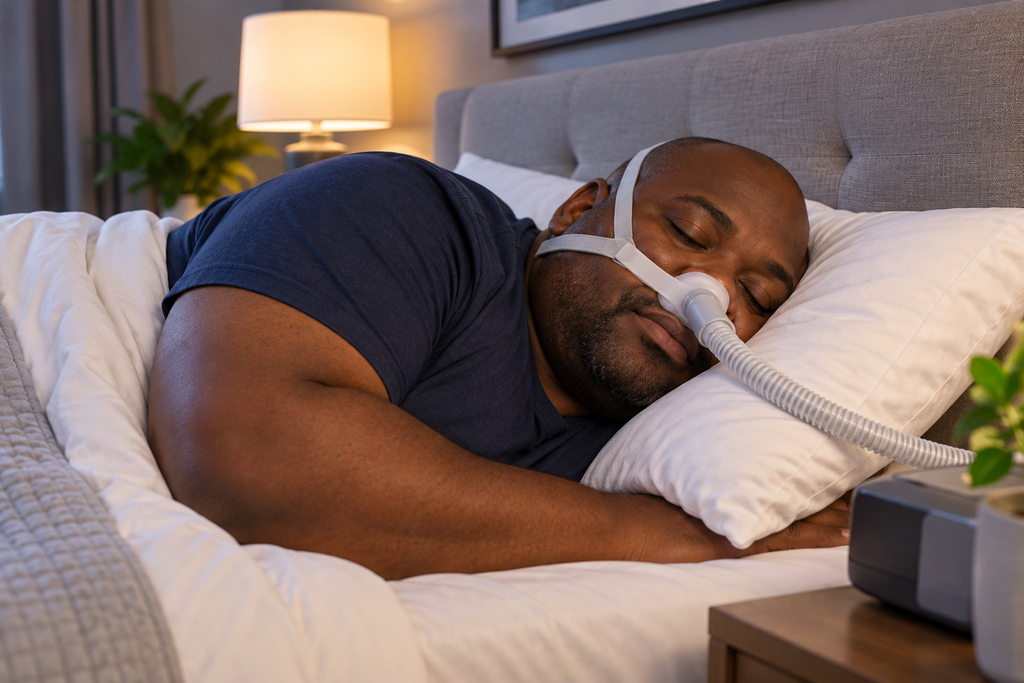
The leak pattern can provide clues.
If leakage appears almost exclusively when one side of the mask touches the pillow, a mechanical pillow-mask interaction becomes particularly likely.
How Do I Know Whether the Air I Feel Is a Leak?
Not all escaping air is abnormal.
CPAP masks intentionally vent exhaled gas.
Therefore, air coming from the designed vent is expected.
Unintentional leak may occur:
A patient should not block intentional venting in an attempt to eliminate airflow.
Why Does My Mask Blow Air Into My Eyes?
Air directed toward the eyes commonly suggests leakage around the upper portion of the mask.
Possible contributors include:
- Incorrect cushion size
- Pillow displacement
- Headgear position
- Cushion wear
- Overtightening
- Facial anatomy
For side sleepers, pillow pressure may push the mask upward or sideways and create an upper seal leak.
Persistent eye-directed airflow should be corrected rather than simply tolerated.
Can CPAP Leak Cause Dry Eyes?
Air leaking toward the eyes may contribute to ocular irritation or dryness in some patients.
But dry eyes can have many causes.
If the mask is visibly leaking toward the eyes, correcting that leak is reasonable.
Persistent or significant eye symptoms deserve appropriate evaluation rather than assuming CPAP is the only possible cause.
Why Does My Mask Make a Whistling Sound?
Possible sources include:
- Cushion leak
- Vent airflow interacting with bedding
- Moisture
- Connection problems
- Damaged components
First identify where the sound originates.
Do not block the intentional vent.
If the noise began after the mask became worn or damaged, inspect replaceable components.
Why Does My CPAP Mask Leak More at Higher Pressure?
Higher delivered pressure may make an existing seal problem more noticeable.
Potential contributors include:
- Cushion fit
- Strap adjustment
- Mask position
- Mouth leak
- Cushion wear
- Pillow displacement
But:
higher pressure = full-face mask required
is not a valid general rule.
Nasal pillows, nasal masks, and full-face interfaces can all function across a range of prescribed PAP pressures when appropriately fitted.
Does APAP Cause More Mask Leak Than CPAP?
Not inherently.
APAP varies pressure within a prescribed range according to the device’s algorithm and detected breathing patterns.
If leak becomes prominent when pressure rises, the higher pressure may expose an interface problem that was less apparent at lower pressure.
The solution may involve:
- Mask fit
- Cushion size
- Mouth leak
- Position
- Treatment reassessment
rather than abandoning APAP.
Should I Tighten My Mask Before Going to Sleep on My Side?
Not simply because you sleep laterally.
Excessive tightening can cause:
- Facial discomfort
- Pressure marks
- Skin irritation
- Cushion distortion
- Poor sleep
Fit the mask according to manufacturer instructions and evaluate it while lying in the actual sleeping position.
Make small adjustments when needed.
Why Does My Mask Leak Even Though It Is Very Tight?
Because tighter is not always better.
Some cushions need enough freedom to maintain their intended shape under PAP pressure.
Excessive strap tension can distort the interface.
If a mask requires extreme tightening, consider whether the problem is:
- Wrong size
- Wrong interface
- Worn cushion
- Pillow interference
- Hose pull
- Headgear positioning
rather than insufficient force.
Can a CPAP Pillow Stop Mask Leak?
It may help when pillow-mask contact is the dominant problem.
A CPAP pillow with appropriate contours or cutouts may create more room for the interface.
But it cannot correct:
- Mouth leak
- Wrong mask size
- Worn cushion
- Poor headgear fit
- Inappropriate interface
- Treatment pressure problems
- A pillow should solve a pillow-related problem. Specialized CPAP pillows with contours or mask cutouts may help selected side sleepers when direct pillow-mask contact is contributing to leak or discomfort, but they are not necessary for everyone.
Can I Cut a Hole in My Regular Pillow?
Some people modify bedding to create mask clearance, but a commercially designed or appropriately positioned pillow may be more predictable.
Whatever strategy is used, maintain:
- Neck support
- Comfortable alignment
- Mask stability
- Unobstructed venting
Avoid creating an unstable sleeping surface simply to accommodate the mask.
Is a Top-of-the-Head CPAP Hose Better for Side Sleeping?
It can be particularly useful for active sleepers.
A top connection can reduce:
- Front-hose drag
- Tubing across the chest
- Hose interaction with the pillow
- Pull while turning
But many top-hose designs route airflow through side frames.
Therefore, the design trades:
less front-hose interference
for:
additional side-frame structure.
That tradeoff works extremely well for some people and less well for others.
What Happens if My Pillow Compresses One Side of a Hollow CPAP Frame?
Frame-airflow masks are designed differently from traditional front-hose masks.
If the pillow presses against one side of a frame, the user may still receive airflow through the system’s remaining pathway depending on the design.
However, pillow pressure can still affect:
- Comfort
- Frame position
- Cushion stability
- Noise
Do not intentionally clamp or obstruct mask components.
The mask should be used according to manufacturer instructions.
Can I Put My CPAP Hose Above My Head?
Many patients route tubing above or behind the sleeping area to reduce drag.
If doing so:
- Maintain adequate slack
- Avoid sharp kinks
- Avoid excessive tension
- Avoid wrapping tubing around the neck
- Avoid blocking airflow
- Prevent trip or entanglement hazards
A hose holder may be useful for some people but is not mandatory.
Can Facial Hair Cause CPAP Mask Leak?
Yes, depending on where the mask seals.
Hair between a cushion and the skin can complicate sealing.
This is particularly relevant for some full-face masks.
Nasal pillows may avoid much of the beard because their seal occurs around the nostrils.
But nasal pillows are only appropriate when nasal therapy itself is suitable.
Do not choose a mask solely based on facial hair while ignoring mouth leak and nasal breathing.
Should I Shave My Beard for CPAP?
Not necessarily.
Some patients with facial hair achieve adequate PAP seals.
Before making a major grooming change, evaluate:
- Mask type
- Cushion position
- Size
- Leak location
- Headgear
- Whether another interface seals more effectively
For some patients, trimming hair in the seal area may help, but complete shaving is not universally necessary.
What Is the Best CPAP Mask for a Side Sleeper With a Beard?
There is no universal winner.
If nasal therapy is appropriate, nasal pillows may be attractive because the seal occurs away from much of the beard.
Potential options include:
AirFit P10
AirFit P30i
and:
F&P Nova Micro.
If oral coverage is required, careful full-face fitting remains necessary.
What Is the Best CPAP Mask for Side Sleepers Who Breathe Through Their Mouth?
If clinically important oral leak makes nasal therapy ineffective, a full-face interface may be appropriate.
Our leading side-sleeper options in this guide are:
AirFit F40
and:
AirFit F30i.
But do not diagnose significant mouth leak based solely on waking with dry mouth.
Dry mouth has multiple possible causes.
Can a Chin Strap Let Me Use a Nasal Mask?
In selected patients, a chin strap may help address jaw opening or oral leak.
But it is not a universal solution.
If significant oral leak persists, the overall PAP interface strategy should be reassessed.
A patient should not accumulate:
nasal mask + chin strap + mouth tape + multiple other accessories
without understanding the problem being treated.
What About Mouth Taping With CPAP?
Mouth taping has become popular online, but it should not be treated as a routine universal solution to PAP mouth leak.
Potential concerns include:
- Nasal obstruction
- Skin irritation
- Difficulty removing the tape
- Anxiety or claustrophobia
- Aspiration/vomiting concerns
- Inappropriate use in patients who cannot reliably breathe through the nose
- Failure to address the actual cause of leak
Patients considering mouth taping should discuss whether it is appropriate for their circumstances with a qualified clinician rather than assuming it is necessary to make a nasal mask work.
What Is the Best Mask for CPAP Dry Mouth?
There is no single “dry-mouth mask.”
First identify why the mouth is dry.
If substantial oral leak occurs with nasal PAP, interface choice may be important.
If the cause is:
- Inadequate humidification
- Medication
- Nasal obstruction
- Environmental dryness
- Another medical problem
switching to a full-face mask may not solve it.
See CPAP Dry Mouth: Causes and Solutions.
What if I Have Allergies or Nasal Congestion?
Nasal congestion can interfere with nasal PAP.
Potential contributors include:
- Allergic rhinitis
- Nonallergic rhinitis
- Nasal dryness
- Structural obstruction
- Acute illness
A full-face mask may be useful in selected circumstances, but chronic nasal problems also deserve appropriate evaluation and treatment.
The goal should not be simply to bypass a treatable nasal problem indefinitely.
Can a Humidifier Improve Mask Comfort?
Humidification can improve nasal or oral comfort for some PAP users.
But humidification does not mechanically correct a poorly fitting cushion.
Think of these as different problems:
dryness → humidification may help
seal displacement → mask/pillow/fit problem
mouth leak → interface or oral-leak problem
Correctly identifying the problem prevents unnecessary purchases.
What Is CPAP Rainout?
Rainout refers to condensation accumulating in PAP tubing or the mask.
It can contribute to:
- Water droplets
- Gurgling
- Sleep disruption
- Uncomfortable moisture
Potential solutions depend on the PAP system and may involve:
- Heated tubing
- Humidifier adjustment
- Room temperature
- Tubing insulation
- Machine position
Can Side Sleeping Make Rainout Worse?
Side sleeping itself is not the fundamental cause of rainout.
But tubing position can influence where condensed water travels.
A poorly routed hose may allow water to collect near the mask.
The underlying issue remains temperature/humidity-related condensation rather than the side-sleeping position alone.
Why Does My Mask Leave a Mark on My Nose or Cheek?
Potential causes include:
- Excessive strap tension
- Incorrect size
- Cushion pressure
- Pillow pressure
- Headgear position
- Skin sensitivity
A side sleeper may experience additional pressure where:
pillow → mask → skin
creates a compression point.
Persistent pain or skin injury should not be accepted as the price of PAP treatment.
What if the Skin Is Actually Breaking Down?
Skin breakdown deserves prompt attention.
Do not continue repeatedly applying substantial pressure to injured skin without addressing the cause.
Possible responses may include:
- Mask refitting
- Alternative interface
- Pressure reduction at the contact point
- Appropriate skin care
- Professional assessment
Significant wounds or signs of infection require medical attention.
Can Mask Liners Help Side Sleepers?
Potentially.
Mask liners may improve comfort or reduce certain skin and leak problems in selected users.
But they add another layer to the seal.
A liner should not be used to compensate for:
- Wrong mask size
- Severe cushion displacement
- Broken equipment
- Fundamentally unsuitable interface
Why Does My Mask Start Leaking After Several Hours?
Several things can change during the night:
- Sleep position
- REM sleep
- PAP pressure
- Facial oils
- Perspiration
- Jaw position
- Cushion position
- Headgear position
A mask that seals at bedtime may therefore behave differently at 4 AM.
The pattern of when leak occurs can help identify the cause.
Why Does My Mask Leak More During REM Sleep?
REM can be associated with:
- Different body position
- Greater upper-airway vulnerability
- Changes in PAP pressure with APAP
- Muscle-tone changes
- Jaw movement
If the mask leaks during REM, determine whether the cause is actually REM itself or one of these associated changes.
See REM-Related Sleep Apnea: What Does REM AHI Mean?
Why Does My Mask Leak Only Near Morning?
Possible explanations include:
- More REM sleep later in the sleep period
- Position changes
- Increased pressure
- Headgear movement
- Facial oils or moisture
- Mouth opening
- Cushion displacement
Rather than simply tightening the mask before bed, look at the timing and pattern.
Can Weight Loss Change CPAP Mask Fit?
Potentially.
Substantial changes in:
- Facial soft tissue
- Neck circumference
- Jaw/cheek contour
may affect mask fit.
Weight change can also alter OSA severity and PAP requirements in some patients.
A previously successful mask or pressure setting may therefore deserve reassessment after substantial weight change.
Can Weight Gain Change Mask Fit?
Yes.
Changes in facial or neck anatomy may affect:
- Cushion fit
- Headgear
- Leak
- PAP requirements
Again, treatment should evolve when the patient’s physiology changes.
Can Dentures Affect Full-Face Mask Fit?
Potentially.
Removing dentures may change:
- Facial contour
- Lip support
- Jaw relationship
which can alter how some full-face cushions seal.
Patients with substantial dental or craniofacial changes may benefit from individualized fitting.
Can a CPAP Mask Cause Jaw Pain?
Mask pressure, headgear, sleeping position, or another condition may contribute to jaw discomfort in some patients.
Persistent jaw pain deserves evaluation rather than simply increasing strap tension or changing accessories repeatedly.
What if the Mask Is Comfortable but I Still Hate CPAP?
Then the mask may not be the main problem.
Other PAP barriers include:
- Pressure intolerance
- Aerophagia
- Nasal obstruction
- Dryness
- Insomnia
- Claustrophobia unrelated to mask size
- Difficulty exhaling
- Treatment expectations
- Another sleep problem
A new mask cannot solve a non-mask problem.
What if CPAP Works but I Cannot Keep It On All Night?
First determine why usage stops.
If the problem is:
mask discomfort or leak
then changing the interface may help.
If the problem is:
pressure, nasal obstruction, aerophagia, insomnia, or another issue
the treatment strategy should address that issue.
If PAP remains difficult despite addressing mask fit and comfort, see CPAP Not Working? Signs Your Sleep Apnea Treatment Needs Reassessment. and Why Do I Take My CPAP Mask Off in My Sleep? Causes and Solutions.
Does Taking the Mask Off During Sleep Mean I Need a Different Mask?
Sometimes—but not automatically.
If you repeatedly remove the mask without remembering it, investigate what happens before removal.
Possible triggers include:
- Mask leak
- Pressure against the pillow
- Facial discomfort
- Nasal obstruction
- Dry mouth
- Claustrophobia
- Hose pulling
- Pressure intolerance
- Aerophagia
- Sleep fragmentation
If the mask itself is the problem, another interface may help.
But if the actual problem is pressure intolerance or nasal obstruction, buying another mask may accomplish very little.
Can a Side Sleeper Use a Nasal Mask Instead of Nasal Pillows?
Absolutely.
This guide emphasizes nasal pillows and nasal cradle designs because their smaller profiles are particularly relevant to pillow interference.
That does not mean conventional nasal masks are inappropriate for side sleepers.
A traditional nasal mask may provide an excellent seal for someone whose:
- Facial anatomy fits it well
- Pillow does not significantly displace it
- Headgear remains stable
- Nasal breathing is adequate
Do not abandon a successful conventional nasal mask simply because it did not win a category in this article.
What About Traditional Full-Face Masks?
The same principle applies.
We emphasized minimal-contact full-face designs because they offer less front-of-face structure.
But some patients achieve their most reliable seal with a conventional full-face mask.
A larger interface that:
fits correctly + stays sealed + remains comfortable + is used all night
is preferable to a smaller mask that repeatedly leaks.
Does a More Expensive Mask Seal Better?
Not necessarily.
Price does not directly measure:
- Facial compatibility
- Cushion stability
- Comfort
- Mouth-leak control
- Side-sleep performance
A relatively inexpensive mask that matches the patient’s anatomy may outperform a more expensive design.
Does a Newer Mask Mean a Better Mask?
No.
Newer designs may introduce useful features such as:
- Smaller cushions
- Different materials
- Simplified headgear
- Top-of-the-head tubing
- Reduced facial coverage
But older masks may remain excellent choices for individual patients.
Product age should not replace fit and treatment performance.
Can Women and Men Use the Same CPAP Masks?
Many masks are designed for a broad range of users and offer different:
- Cushion sizes
- Frame sizes
- Headgear configurations
The relevant issue is not simply sex.
It is whether the mask appropriately fits the individual’s:
- Nose
- Face
- Head
- Jaw
- Treatment needs
Manufacturer sizing guidance should be used for the specific product.
What if I Have a Small Face?
A smaller face does not automatically mean that every component should be the smallest available.
Some masks separately size:
- Cushion
- Frame
- Headgear
Use the manufacturer’s sizing system rather than guessing from overall body size.
Fit packs may be particularly useful when cushion size is uncertain.
What if I Have a Large Face or Head?
The same principle applies.
Check:
- Cushion options
- Frame sizes
- Headgear sizing
before purchasing.
A mask may offer an appropriate cushion but require a different frame or headgear configuration.
Can Side Sleeping Cause the Mask to Move My Jaw?
Pillow pressure against a mask—particularly a larger interface—can transmit force to the face or jaw.
Headgear tension can also influence comfort.
If the mask causes:
- Jaw pain
- Significant pressure
- Repeated displacement
- Morning discomfort
reassess the fit rather than simply tightening the straps further.
What if My Pillow Pushes My Full-Face Mask Into My Mouth?
That suggests a direct mechanical interaction between the pillow and interface.
Potential strategies include:
- Repositioning closer to the pillow edge
- Reassessing pillow height or firmness
- Checking mask size
- Adjusting headgear appropriately
- Considering a lower-profile full-face design
The appropriate solution depends on whether the current mask otherwise works well.
Can I Sleep With My Face Partly Off the Pillow?
Some side sleepers find this comfortable and useful for mask clearance.
The objective is to support:
head + neck
while reducing:
direct pillow pressure against the interface.
But don’t sacrifice comfortable cervical alignment solely to preserve the mask seal.
What if My Shoulder Makes Side Sleeping Difficult?
This may become more of a sleep-position problem than a CPAP-mask problem.
Shoulder pain can limit lateral sleep regardless of mask design.
A different pillow or positioning strategy may help, but persistent musculoskeletal pain deserves appropriate evaluation.
Do not repeatedly change PAP masks when the primary problem is actually shoulder discomfort.
Is Sleeping on the Left Side Better Than the Right Side for CPAP?
Not universally.
For mask mechanics, the better side is generally whichever permits:
- Comfortable sleep
- Stable seal
- Unobstructed venting
- Appropriate body positioning
Individual medical conditions may create other reasons to favor a particular sleeping position, but there is no universal CPAP-mask rule that everyone should sleep on the left or right.
Can I Sleep on My Side After Starting CPAP for the First Time?
Yes, assuming there is no separate medical reason you have been instructed to avoid that position.
In fact, fitting the mask in your normal sleeping position from the beginning may help identify problems before they become habitual.
How Long Should I Give a New CPAP Mask Before Deciding It Doesn’t Work?
There is no universal number of nights.
Some problems are immediately obvious.
For example:
- Clearly incorrect size
- Severe pressure
- Significant skin reaction
- Persistent major leak
- Intolerable nasal discomfort
Other issues improve after:
- Learning the fitting technique
- Making small headgear adjustments
- Improving hose routing
- Becoming accustomed to the interface
A return/exchange deadline should also be considered.
Do not wait beyond a retailer’s eligible exchange period merely because you believe you must “give it more time.”
Should I Change Several Things at Once?
Usually, troubleshooting is easier when changes are deliberate.
Suppose you simultaneously change:
mask + pillow + humidity + pressure + chin strap.
If treatment improves, you may not know why.
When clinically safe and appropriate, changing one major variable at a time can make the cause clearer.
Do not independently change prescribed PAP settings simply to conduct an experiment.
How Do I Know Whether My New Mask Is Actually Better?
Compare meaningful outcomes.
Ask:
- Is leak improved?
- Is comfort improved?
- Am I waking less often?
- Can I use PAP longer?
- Is mouth leak controlled?
- Are pressure marks reduced?
- Is the mask staying stable when I turn?
- Is PAP efficacy still adequate?
A mask that merely looks better or feels lighter for five minutes is not necessarily an improvement.
Should I Look at My CPAP Data After Changing Masks?
Yes, when appropriate.
Useful information may include:
- Usage duration
- Leak
- Residual respiratory-event data
- Pressure behavior
- Other device-specific information
But device data should be interpreted appropriately.
Different manufacturers may calculate or display leak differently.
A single number should not be interpreted without context.
Can the Wrong Mask Make CPAP Look Like It Is Not Working?
Potentially.
Substantial unintentional leak can interfere with:
- Therapy delivery
- Comfort
- Sleep
- Device performance
- Interpretation of treatment data
Therefore, when PAP appears ineffective, mask/interface problems are among the issues worth evaluating.
But they are not the only possible explanation.
What if My Residual AHI Is High Even Though the Mask Doesn’t Leak?
Then the problem may not be the mask.
Possible considerations include:
- Pressure/settings
- Event type
- Treatment usage
- Central events
- Sleep position
- REM-related disease
- Other clinical factors
Do not keep purchasing masks to treat a problem that isn’t caused by the interface.
If PAP remains difficult despite addressing mask fit and comfort, see CPAP Not Working? Signs Your Sleep Apnea Treatment Needs Reassessment.
Can a Mask Fix Central Sleep Apnea?
No.
Changing CPAP-mask style does not convert central respiratory events into obstructive ones.
If significant central events are suspected or reported, the breathing disorder and treatment strategy require appropriate clinical assessment.
See Central vs. Obstructive Sleep Apnea: What’s the Difference?
Can a Mask Fix Low Oxygen Levels?
Only indirectly when the oxygen abnormality is caused by inadequately treated obstructive events related to poor PAP delivery or major leak.
Low nocturnal oxygen can have other causes, including:
- Pulmonary disease
- Hypoventilation
- Cardiac disease
- Persistent sleep-disordered breathing
- Other conditions
Do not treat unexplained hypoxemia as a mask-shopping problem.
See Sleep Apnea and Oxygen Levels: How Low Is Too Low?
Can a Better Mask Lower My AHI?
Potentially, if the previous interface produced clinically important leak or prevented adequate PAP use.
But a new mask does not inherently lower AHI simply because it is newer or more expensive.
The mechanism would be:
better interface → better seal/use → more effective PAP exposure
rather than:
premium mask → intrinsically lower AHI.
Is Mask Comfort Really That Important?
Yes.
PAP works only during the periods in which it is actually used.
A physiologically excellent treatment that repeatedly comes off after one hour provides much less treatment exposure than PAP used throughout sleep.
Comfort therefore matters because it can influence sustainable use.
But comfort cannot be the only objective.
A comfortable mask with uncontrolled major leak is not an adequate solution.
What Is More Important: Comfort or Seal?
Both.
The goal is not:
perfect seal at any cost
or:
maximum comfort regardless of leak.
It is:
a sufficiently stable seal with enough comfort to allow effective PAP use throughout sleep.
What Is More Important: Mask Type or Mask Fit?
Both matter, but fit can dominate the experience.
A theoretically ideal side-sleeper design in the wrong size may perform poorly.
A less fashionable mask that matches the patient’s face extremely well may perform beautifully.
This is why our rankings narrow the field rather than prescribe a universal winner.
Should Everyone Start With the AirFit P30i Because We Ranked It #1?
No.
Our Best Overall designation reflects the combination of characteristics we consider useful for many side sleepers:
nasal pillows + low frontal profile + top-of-the-head hose + movement-oriented architecture.
But consider:
Patient A
Nasal breathing is excellent, nasal pillows are comfortable, and the patient turns frequently.
P30i may be highly attractive.
Patient B
Severe persistent mouth leak prevents nasal therapy.
P30i may be a poor choice despite ranking #1 overall.
Patient C
The patient cannot tolerate nasal pillows.
N30i may be more appropriate.
Patient D
The patient hates side frames but manages a front hose easily.
P10 or Nova Micro may be preferable.
Patient E
Full-face therapy is needed and front-hose pull is the main problem.
F30i may be more logical.
This is why:
“Best overall” is not the same as “best for everyone.”
Should You Ask Your Sleep Clinician or DME Provider About Mask Choice?
Yes, particularly when:
- PAP treatment is not working well
- Leak remains substantial
- Mouth leak is uncertain
- Significant nasal obstruction exists
- Skin injury occurs
- Pressure intolerance persists
- The patient repeatedly removes the mask
- Residual respiratory events remain elevated
- Multiple masks have failed
A knowledgeable PAP clinician or DME professional may also help with sizing and fitting.
What Should You Bring to a Mask-Fitting Appointment?
Useful information can include:
- Current mask
- PAP machine or device information when requested
- Typical leak data
- Pressure information
- Description of normal sleep position
- Where the current mask leaks
- Whether mouth leak occurs
- Whether the hose pulls
- Which facial areas become painful
If practical, explaining:
“It seals on my back but leaks when I lie on my right side”
is much more useful than simply saying:
“The mask doesn’t work.”
Should You Tell the Fitter You Are a Side Sleeper?
Absolutely.
Also tell them whether you:
- Stay on one side
- Switch sides frequently
- Sleep partly prone
- Use a very firm pillow
- Have shoulder problems
- Experience hose tangling
- Need oral coverage
- Dislike nasal pillows
Mask fitting should reflect the patient’s real sleeping behavior.
The Most Important Troubleshooting Question
When a CPAP mask isn’t working, ask:
“What exactly is failing?”
Is it:
the cushion seal?
mouth leak?
hose management?
pillow pressure?
nasal comfort?
headgear?
skin pressure?
claustrophobia?
pressure tolerance?
or:
something unrelated to the mask?
part 3A saved
Once the failure mechanism is identified, the solution becomes much more rational.
Which CPAP Mask Should a Side Sleeper Choose?
After comparing the designs, the decision can be simplified considerably.
The first question is not:
“Which mask ranked #1?”
It is:
“What problem does my current mask—or my first mask—need to solve?”
The answer should determine which features matter most.
Side-Sleeper CPAP Mask Decision Table
| Your Situation | Mask to Consider First | Why | Important Caveat |
|---|---|---|---|
| Nasal breathing + frequent turning | AirFit P30i | Nasal pillows + top-of-head hose | Side frame can contact pillow |
| Nasal breathing + wants minimal facial contact | AirFit P10 | Very small facial footprint | Front hose requires management |
| Nasal breathing + wants ultra-lightweight design | F&P Nova Micro | Very compact nasal-pillow interface | No top-hose advantage |
| Dislikes nasal pillows + turns frequently | AirFit N30i | Under-nose cradle + top hose | Side frame can contact pillow |
| Needs full-face therapy + prioritizes minimal structure | AirFit F40 | Minimal-contact under-nose full-face design | More seal surface than nasal interfaces |
| Needs full-face therapy + turns frequently | AirFit F30i | Oral coverage + top-of-head hose | Side frame can contact pillow |
| Headgear adjustment is the major frustration | F&P Solo | AutoFit fitting approach | Not selected primarily for side-sleep geometry |
| Wants another top-hose nasal platform | Philips DreamWear | Frame airflow + top-of-head connection | Pillow can interact with side frame |
| Current mask works well | Keep current mask | No reason to replace effective therapy solely because another mask ranks higher | Reassess if leak, comfort, or efficacy changes |
This table is a decision aid, not an individualized prescription. The correct mask depends on nasal breathing, mouth leak, facial anatomy, PAP treatment, comfort, sizing, movement, pillow interaction, and other clinical factors.
Our Final Picks
Best Overall — ResMed AirFit P30i
The P30i earns our overall designation because it combines:
nasal pillows
low frontal profile
top-of-the-head tubing
movement-oriented architecture.
That combination addresses two important side-sleeper problems:
pillow-mask interaction
and:
hose drag while turning.
Its principal tradeoff is the airflow-carrying side frame.
For someone who strongly dislikes cheek-frame contact, a simpler minimalist design may be preferable.
Best Minimalist — ResMed AirFit P10
Choose the P10 when:
less mask on the face
matters more than:
moving the hose connection to the top of the head.
Its small nasal-pillow interface makes it particularly attractive for relatively still side sleepers and people who dislike substantial facial hardware.
Best Ultra-Lightweight — Fisher & Paykel Nova Micro
Nova Micro stands out because Fisher & Paykel identifies it as its smallest and lightest PAP mask.
For a side sleeper seeking:
minimal weight + minimal facial structure
it deserves serious consideration.
Its primary tradeoff is that the main tubing remains a consideration for movement and hose management.
Best Nasal Cradle — ResMed AirFit N30i
N30i fills an important gap.
It provides:
under-the-nose nasal therapy
without requiring:
nasal pillows at the nostrils.
Its top-hose architecture is particularly attractive for active sleepers.
Best Minimal Full Face — ResMed AirFit F40
For patients who need oral coverage, F40 provides a lower-profile alternative to many traditional full-face designs.
Its under-the-nose architecture makes it particularly relevant when the patient wants to reduce:
nasal-bridge coverage + front-of-face structure.
Best Full Face for Active Side Sleepers — ResMed AirFit F30i
F30i combines:
full-face/oral coverage
with:
top-of-the-head tubing.
That makes it particularly attractive when the patient both:
needs a full-face interface
and:
turns frequently during sleep.
Which Mask Would We Choose for a First-Time CPAP User?
There is no universal first mask.
Start by determining whether nasal therapy is appropriate.
If:
nasal breathing is adequate + mouth leak is not clinically important
then a nasal interface is often worth considering.
For an active side sleeper comfortable with nasal pillows, the P30i would be high on our list.
For someone who dislikes nasal pillows, N30i may be more attractive.
For someone prioritizing minimalism, P10 or Nova Micro may make more sense.
If oral coverage is genuinely needed, F40 or F30i becomes more relevant.
The first mask should be selected according to the patient’s needs rather than automatically starting everyone with the same interface.
When Should You NOT Buy a New CPAP Mask?
This may be one of the most important sections in a buying guide.
Do not automatically purchase another mask when:
- Your current mask is comfortable
- Leak is adequately controlled
- PAP is effective
- You use therapy throughout sleep
- The only reason for changing is that another mask is newer
- The only reason is an online ranking
- The actual problem is unrelated to the mask
For example:
high residual AHI + low leak
does not automatically mean:
buy another mask.
Likewise:
aerophagia + excellent mask seal
does not necessarily call for another interface.
And:
nasal obstruction
may require addressing the nasal problem rather than repeatedly changing masks.
When Does Buying a Different Mask Make More Sense?
A different mask becomes more reasonable when the current interface repeatedly causes a specific problem such as:
- Pillow-induced leak
- Intolerable facial pressure
- Nasal-pillow discomfort
- Clinically important mouth leak
- Severe claustrophobia
- Hose pull that cannot be managed
- Poor fit despite correct sizing
- Repeated skin injury
- Inability to sustain PAP use because of the interface
The key phrase is:
because of the interface.
If the mask isn’t causing the treatment problem, changing it may not solve the treatment problem.
Should You Keep Your Old Mask After Switching?
If it remains functional, hygienic, compatible with your equipment, and appropriate for your treatment, an older mask may sometimes serve as a backup.
That can be useful if:
- A component of the new mask breaks
- Replacement parts are delayed
- The new mask becomes temporarily uncomfortable
- Travel creates an equipment problem
Follow appropriate cleaning and replacement guidance.
What About Buying Used CPAP Masks?
Because CPAP masks contact the:
- Face
- Nose
- Mouth
- Respiratory secretions
used interfaces raise hygiene and product-integrity concerns.
For personal medical equipment, purchasing appropriate new components from reputable sources is generally preferable to obtaining an unknown used interface.
Should You Buy Replacement Parts From Unfamiliar Sellers?
Price alone should not determine the source.
Consider:
- Product authenticity
- Compatibility
- Seller reputation
- Return policy
- Manufacturer support
- Correct model identification
An inexpensive cushion that does not actually match the intended mask is not a bargain.
Beware of Look-Alike Product Names
CPAP mask families can contain very similar names.
For example:
P30i
and:
N30i
belong to related systems but use different interface types.
Likewise:
F30
F30i
and:
F40
should not be treated as interchangeable names.
Before purchasing, verify the exact:
manufacturer + model + interface + size + package contents.
Don’t Confuse a Cushion With a Complete Mask
This is one of the easiest online-shopping mistakes to make.
A product listing may show a familiar mask photograph while selling only:
- Cushion
- Pillows
- Frame
- Headgear
- Elbow
If the price seems dramatically lower than competing listings, inspect what is actually included.
For our future price tables, Sleep Breathing Guide will compare equivalent configurations whenever possible.
Should You Buy a Mask Because It Is on Sale?
A discount can make an appropriate mask more affordable.
It does not make an inappropriate mask suitable.
The correct sequence is:
identify appropriate mask
↓
compare reputable sellers
↓
evaluate return policy
↓
compare equivalent packages
↓
consider current price
not:
find biggest discount → decide that must be the best mask.
How Will Sleep Breathing Guide Handle Affiliate Links?
Some product links on Sleep Breathing Guide may be affiliate links. If an eligible purchase is made through certain links, Sleep Breathing Guide may receive a commission at no additional cost to the reader.
Affiliate relationships do not determine which products are included, excluded, ranked, or recommended.
Product links may lead to manufacturers, retailers, informational resources, or affiliate partners. Commercial relationships are disclosed where applicable.
For additional information, see our Affiliate Disclosure.Some product links on Sleep Breathing Guide may be affiliate links. If an eligible purchase is made through certain links, Sleep Breathing Guide may receive a commission at no additional cost to the reader.
Affiliate relationships do not determine which products are included, excluded, ranked, or recommended.
Product links may lead to manufacturers, retailers, informational resources, or affiliate partners. Commercial relationships are disclosed where applicable.
For additional information, see our Affiliate Disclosure.
But the editorial sequence remains:
evaluate product
↓
select recommendation
↓
identify appropriate purchasing sources
↓
add disclosed affiliate relationship where available.
Not:
find commission
↓
create recommendation.
Why We Don’t Hard-Code One Price Into the Recommendation
CPAP-mask prices can change because of:
- Promotions
- Retailer pricing
- Package configuration
- Included sizes
- Insurance
- Coupons
- Replacement-component listings
Therefore, a statement such as:
“This mask costs exactly $115.”
can quickly become inaccurate.
Where useful, we may provide:
approximate price range + current-price link
with the date or context of the comparison.
What About Star Ratings?
We may consider recurring themes from consumer experience when useful, but star ratings do not determine our ranking.
A mask with thousands of reviews may simply:
- Have been sold longer
- Have greater distribution
- Have a larger installed user base
than a newer product.
Likewise, a newer mask may have excellent design characteristics but relatively few reviews.
Review count is not clinical evidence of superiority.
Ten Questions to Ask Before Buying a CPAP Mask for Side Sleeping
1. Do I Need Nasal or Full-Face Therapy?
Determine whether clinically important oral leak or another factor requires oral coverage.
2. Do I Tolerate Nasal Pillows?
If not, don’t buy a nasal-pillow mask merely because it ranks highly.
3. How Much Do I Move During Sleep?
Frequent turning increases the importance of hose management.
4. What Part of My Current Mask Hits the Pillow?
Identify the actual mechanical problem.
5. Is My Current Mask the Correct Size?
Don’t replace the model before checking size.
6. Is the Cushion Worn?
A replacement cushion may solve a new leak problem.
7. Is the Hose Pulling on the Mask?
If yes, routing or a top-hose design may help.
8. What Exactly Is Included in the Product Listing?
Complete mask and replacement cushion are not equivalent purchases.
9. What Is the Return or Exchange Policy?
Mask fit is difficult to predict before actual use.
10. What Problem Will This Purchase Solve?
If you cannot answer that question, reconsider whether you need another mask.
Eight Common CPAP Mask Buying Mistakes
Mistake 1: Buying the #1-Ranked Mask Without Considering Interface Type
A nasal-pillow winner is irrelevant if nasal-pillow therapy is inappropriate for you.
Mistake 2: Assuming “Side-Sleeper Mask” Is a Separate Medical Category
There is no single interface that all side sleepers require.
Side sleeping is one factor among several.
Mistake 3: Choosing Full Face Solely Because You Sometimes Breathe Through Your Mouth
Determine whether clinically important oral leak actually occurs during PAP.
Mistake 4: Buying a New Mask When the Cushion Is Simply Worn
Inspect replaceable components first.
Mistake 5: Overtightening Every New Mask
More tension does not necessarily mean less leak.
Mistake 6: Comparing Replacement-Part Prices With Complete Masks
Verify package contents.
Mistake 7: Ignoring the Return Policy
Fit uncertainty makes exchange terms particularly important.
Mistake 8: Choosing Based on Affiliate Commission or Discount Size
Commercial economics should not determine medical or editorial suitability.
A Practical Final Decision Path
Start with:
Do You Need Oral Coverage?
No → consider nasal therapy
Yes → evaluate full-face options
Then:
Do You Tolerate Nasal Pillows?
If yes:
P30i → active sleeper/top hose
P10 → minimalist
Nova Micro → ultra-lightweight/minimalist
If no:
N30i → under-nose cradle/top hose
DreamWear → alternative top-hose platform
If full-face therapy is needed:
F40 → prioritize minimal structure
F30i → prioritize top-hose movement freedom
Then:
Fit It in the Real Sleeping Environment
PAP running
actual pillow
right side
left side
normal movement.
Then ask:
Does it remain comfortable and adequately sealed?
That answer matters more than its ranking.
The Bottom Line
The best CPAP mask for side sleepers is not a single universal product.
Side sleeping creates several potential mechanical challenges:
- Pillow pressure against the cushion
- Frame displacement
- Hose drag
- Headgear movement
- Jaw movement
- Leak during position changes
Different masks solve different parts of that problem.
For many nasal-pillow users who move frequently, the ResMed AirFit P30i offers an appealing combination of a small nasal interface and top-of-the-head tubing, making it our Best Overall selection.
For patients who prioritize minimal facial hardware, the AirFit P10 remains an excellent minimalist choice.
The F&P Nova Micro deserves particular consideration for patients seeking an exceptionally small and lightweight nasal-pillow design.
For patients who dislike nasal pillows but want a low-profile nasal interface with top-hose routing, the AirFit N30i is our leading nasal-cradle choice.
For side sleepers who need oral coverage, the decision changes.
The AirFit F40 is our preferred minimal-contact full-face design, while the AirFit F30i is particularly attractive when oral coverage and top-of-the-head hose management are both priorities.
The F&P Solo and Philips DreamWear remain worthwhile alternatives for patients whose priorities differ from our category winners.
But none of these rankings overrides individual fit.
A mask that is:
smaller
lighter
newer
or:
more expensive
is not automatically better.
The correct mask should match:
nasal breathing + mouth leak + facial anatomy + PAP requirements + movement pattern + pillow interaction + comfort + sizing.
And before replacing a mask that already works, ask:
“What specific problem am I trying to solve?”
Sometimes the answer is a different mask.
Sometimes it is:
- A new cushion
- Better sizing
- Different hose routing
- Pillow repositioning
- Nasal treatment
- Humidification
- PAP troubleshooting
And sometimes:
the best purchasing decision is not to buy anything at all.
For a side sleeper, the final test should occur where the mask actually has to work:
with PAP running, on the actual pillow, in the actual sleeping position, through normal movement during sleep.
That is more meaningful than any product ranking.
References & Further Reading
- Patil SP, Ayappa IA, Caples SM, Kimoff RJ, Patel SR, Harrod CG. Treatment of Adult Obstructive Sleep Apnea With Positive Airway Pressure: An American Academy of Sleep Medicine Clinical Practice Guideline. Journal of Clinical Sleep Medicine. 2019;15(2):335–343.
https://doi.org/10.5664/jcsm.7640 - Srijithesh PR, Aghoram R, Goel A, Dhanya J. Positional therapy for obstructive sleep apnoea. Cochrane Database of Systematic Reviews. 2019;5:CD010990.
https://doi.org/10.1002/14651858.CD010990.pub2 - Rotenberg BW, Murariu D, Pang KP. Trends in CPAP adherence over twenty years of data collection: a flattened curve. Journal of Otolaryngology – Head & Neck Surgery. 2016;45:43.
https://doi.org/10.1186/s40463-016-0156-0 - Weaver TE, Grunstein RR. Adherence to Continuous Positive Airway Pressure Therapy: The Challenge to Effective Treatment. Proceedings of the American Thoracic Society. 2008;5(2):173–178.
https://doi.org/10.1513/pats.200708-119MG - ResMed. AirFit P30i — Patient Information Guide.
https://maskguide.resmed.com/airfit-p30i - ResMed. AirFit P10 — Patient Information Guide.
https://maskguide.resmed.com/airfit-p10 - ResMed. AirFit N30i — Nasal Mask / Patient Information and Product Resources.
https://maskguide.resmed.com/ - ResMed. AirFit F40 — Minimal-Contact Full-Face Mask.
https://www.resmed.com/en-us/healthcare-professional/products-and-support/masks/airfit-f40/ - ResMed. AirFit F30i — Minimal-Contact Full-Face Mask.
https://www.resmed.com/en-us/healthcare-professional/products-and-support/masks/airfit-f30i/ - Fisher & Paykel Healthcare. F&P Nova Micro Mask.
https://www.fphcare.com/us/my-sleep-apnea/products/f-p-nova-micro-mask/ - Fisher & Paykel Healthcare. F&P Solo Mask.
https://www.fphcare.com/us/my-sleep-apnea/products/f-p-solo-mask/ - Philips Respironics. DreamWear Under-the-Nose Nasal Mask — Product Information and Reference Guide. Philips.
https://www.usa.philips.com/sleep-respiratory-care/products/HCNOCTN452/r - Philips Respironics. DreamWear Nasal Sleep Apnea Mask — Fitting and Support. Philips.
https://www.usa.philips.com/c-e/hs/sleep-apnea-therapy/support/dreamwear-nasal.html
Medical Author & Reviewer
Kwaku Osafo-Mensah, MD
Pulmonary Medicine | Sleep Medicine
Diplomate, American Board of Sleep Medicine (ABSM)
More than 20 years of experience in sleep medicineMedically reviewed: September 2026.
About the medical reviewer · Editorial Policy
Medical & Product Disclaimer: This article is provided for general educational and product-comparison purposes and is not a substitute for individualized medical evaluation, diagnosis, treatment, PAP management, mask fitting, or other professional healthcare advice. CPAP mask selection depends on factors including facial and nasal anatomy, nasal breathing, mouth leak, PAP mode and pressure, sleeping position, movement during sleep, skin sensitivity, dental and craniofacial factors, treatment response, and individual comfort. A mask identified as a preferred or “best” option in this guide should not be interpreted as a prescription, guarantee of fit, or prediction that it will provide an adequate seal or effective treatment for a particular person.
Sleep Breathing Guide did not physically test every product discussed in this article. Unless specifically stated otherwise, product evaluations are based on manufacturer specifications and documentation, interface and tubing design, clinically relevant mask characteristics, available product information, and editorial assessment. Manufacturer descriptions establish product characteristics but do not independently establish Sleep Breathing Guide’s comparative rankings. Product specifications, included components, sizing options, availability, prescription requirements, prices, promotions, warranties, return policies, and retailer terms can change. Readers should verify current information with the manufacturer or seller before purchasing.
Some links on this page may be affiliate links. Sleep Breathing Guide may receive a commission when an eligible purchase is made through certain links, at no additional cost to the reader. Affiliate relationships, commission rates, retailer relationships, discounts, or the availability of tracking links do not determine which masks are included, excluded, ranked, or recommended. A product may be discussed or recommended even when no affiliate relationship exists. See our Affiliate Disclosure for additional information.
CPAP users should not independently change prescribed PAP pressures, discontinue effective PAP therapy, intentionally obstruct mask vents, or assume that persistent leak, dry mouth, elevated residual AHI, low oxygen levels, pressure intolerance, or inability to tolerate PAP can always be corrected by purchasing another mask. Persistent treatment problems may require review of mask fit, equipment, PAP data, nasal breathing, oral leak, treatment settings, event type, oxygenation, or other clinical factors. Significant breathing difficulty, severe or unexplained hypoxemia, loss of consciousness, or another medical emergency requires appropriate urgent medical evaluation.